
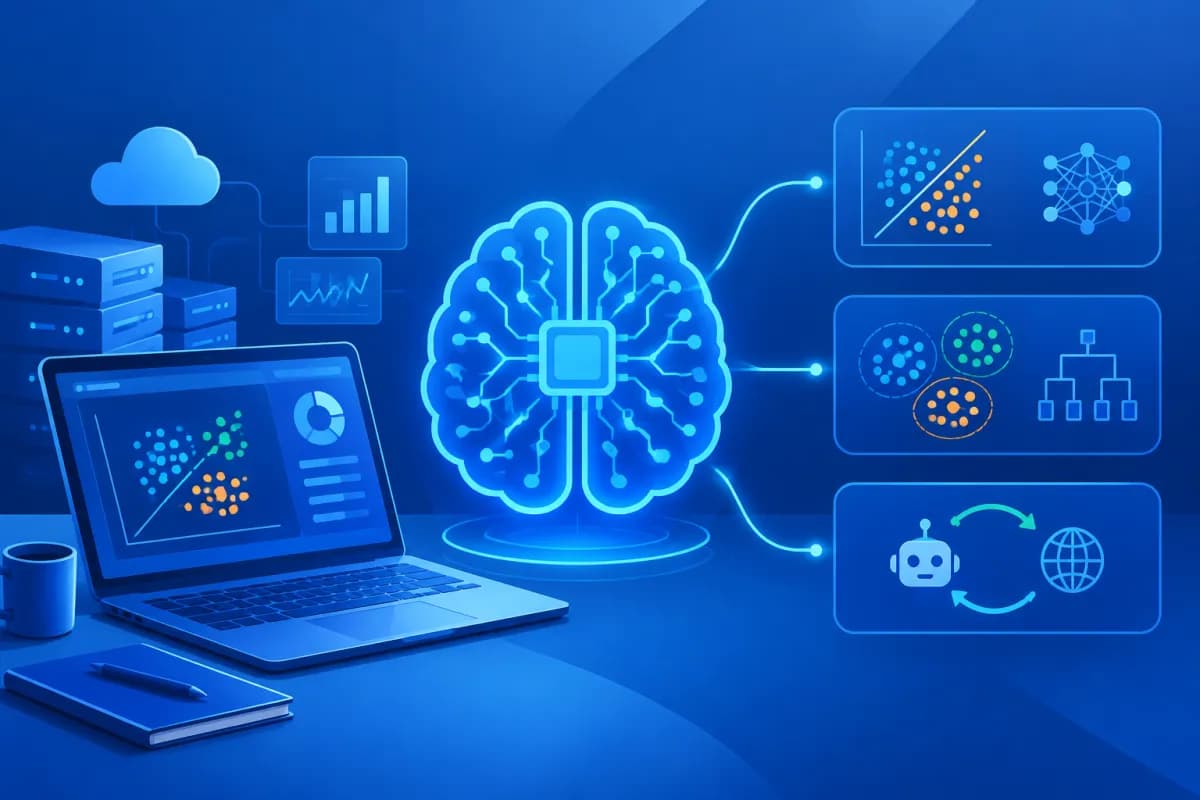
When people hear about artificial intelligence, they often think of chatbots, product recommendation systems, or image recognition software. Behind many of these applications is machine learning, a technology that enables computers to learn from data and make predictions or decisions. So, what is machine learning, and how do the three most common methods differ?
This article explains the concept in plain language and compares supervised, unsupervised, and reinforcement learning through familiar scenarios. It also helps business owners and marketers understand how to apply this technology in practice.
What Is Machine Learning?
Machine learning is a branch of artificial intelligence. Instead of programming rules for every possible scenario, people provide data and a learning method so computers can identify useful patterns. After training, a model can predict outcomes or classify new data it has not encountered before.

Imagine a business wants to predict which customers are likely to make a purchase. A conventional program would need detailed rules—for example, a customer who visits the website more than three times and adds a product to their cart is considered a promising lead. But purchasing behavior is usually more complex than a handful of fixed conditions. A machine learning model can analyze historical data on website visits, content viewed, purchase history, and campaign responses to identify signals commonly associated with a purchase.
The basic process usually involves three steps:
- Collect data: Gather relevant information, ensuring it is of sufficient quality and used in compliance with applicable requirements.
- Train the model: Use data to help the model learn relationships or patterns.
- Evaluate and apply: Test its accuracy on new data, then integrate the model into real-world workflows and continue monitoring it.
Machine learning does not automatically understand everything the way people do. Results depend on the goal, data, training approach, and how the business uses the model. The three most common methods differ mainly in the type of input data and how the system receives feedback.
Supervised Learning: Predicting from Data with Known Answers
Supervised learning trains a model on labeled data, meaning each example comes with a correct answer. The model compares inputs with known outcomes to learn how to predict answers for new cases. You can think of it as a student working through practice problems with an answer key and learning how to solve them.
For example, a bank may have transaction data already identified as normal or suspicious. The model receives information such as transaction amount, time, location, and the customer’s transaction habits, along with the corresponding labels. Once trained, the system can flag new transactions that show signs of fraud for an employee to review.
In business and marketing, supervised learning is commonly used for:
- Lead scoring: Predicting whether a customer is more or less likely to convert based on historical data.
- Revenue forecasting: Estimating sales over time using sales data, seasonality, and marketing activity.
- Sentiment analysis: Classifying reviews or comments as positive, negative, or neutral.
- Risk detection: Identifying transactions, orders, or records that may be unusual.
This method has a clear objective and is easy to evaluate when labeled data is reliable. However, businesses need enough correctly classified examples. If labels are wrong, unrepresentative, or reflect biases in historical data, the model may learn those biases. Preparing the data can sometimes take more time than training the model itself.
Unsupervised Learning: Finding Previously Unknown Groups and Patterns
Unlike supervised learning, unsupervised learning uses data without pre-existing answers or labels. The model identifies similarities, differences, and hidden structures in the data. Rather than being asked to predict a specific outcome, the system is tasked with discovering how the data is organized.

For example, an online store may have information about many customers but not yet have grouped them. A model can analyze purchase frequency, order value, favorite product categories, and return visits to identify behavior-based segments. It might uncover frequent shoppers who place small orders, infrequent shoppers who spend more, or customers who engage only during promotions. Marketers can use these findings to develop more relevant messaging and offers.
Common applications include:
- Customer segmentation: Finding groups with similar behavior or needs when the boundaries between groups are not known in advance.
- Anomaly detection: Identifying data that differs significantly from the rest, such as a sudden spike in spending.
- Topic discovery: Grouping similar feedback or content to uncover issues customers frequently mention.
- Data exploration: Finding relationships between products, behaviors, or customer characteristics to support analysis.
A key strength of unsupervised learning is that it can make use of unlabeled data, which is common in businesses. However, its results do not always have a single clear interpretation. For example, a model dividing customers into four groups does not mean those groups automatically correspond to four meaningful customer personas. Users need to review and validate the results, then name the groups based on their business knowledge.
Reinforcement Learning: Learning Through Actions and Feedback
Reinforcement learning is a method in which an agent learns to choose actions by interacting with an environment. After each action, the system receives a reward or penalty. Its goal is to find a sequence of actions that maximizes the total reward over time.
You can think of it like training a dog: appropriate behavior is rewarded, while inappropriate behavior receives no reward or is discouraged. Through repeated attempts, the agent gradually adjusts its choices. In reinforcement learning, feedback does not necessarily arrive immediately; the impact of a decision may only become clear after several steps.
A simple example is a warehouse robot that needs to reach a picking location without hitting obstacles. The system tries different routes, earns points for reaching its destination quickly and safely, and loses points if it collides with something or takes a detour. Through repeated interactions, the robot improves its route-selection policy.
Businesses may consider this method for problems that require ongoing decision-making, such as optimizing resource allocation, controlling robots, or adjusting operations in a simulated environment. Some marketing scenarios can also be modeled around choosing content or offers, but objectives and safety limits must be carefully designed to avoid creating a poor customer experience.
Reinforcement learning is suitable when a system can interact with an environment and receive feedback on the results. The trade-off is that training is often complex, requires many attempts, and can consume significant resources. For decisions involving customers, finances, or safety, a model should not be allowed to experiment directly without appropriate oversight and a suitable testing environment.
Comparing the Methods and Choosing the Right One
All three methods help computers learn from data, but they address different types of problems. Here is a quick comparison:

- Supervised learning: Uses labeled data; suitable when you need to predict or classify a defined outcome.
- Unsupervised learning: Uses unlabeled data; suitable when you want to discover groups, structures, or anomalies.
- Reinforcement learning: Learns through actions and feedback; suitable when you need to optimize a sequence of decisions in an interactive environment.
To choose an approach, businesses should start with the problem they need to solve, not the name of a technology. If you have labeled historical data and need to predict customer churn, supervised learning may be a good fit. If you do not yet know how customers divide into groups, unsupervised learning can help uncover them. If the problem requires a system to act continuously, observe the results, and adjust, reinforcement learning may be worth considering.
Before implementation, define the business objective and how success will be measured; check whether the data is complete, accurate, and up to date; and consider privacy, security, and accountability when using the results. Not every project needs machine learning. In many cases, clear business rules or traditional data analysis can solve the problem at a lower cost.
A good model is not simply one with high accuracy. It needs to deliver practical value, be controllable, and fit the business’s workflows.
Conclusion: Start with the Business Problem
What is machine learning? It is a way for computers to learn patterns from data so they can make predictions, discover structure, or choose actions. Supervised learning uses data with known answers; unsupervised learning finds structure in unlabeled data; and reinforcement learning improves decisions through interaction and feedback. Understanding these differences helps businesses set realistic expectations and choose an approach that meets their needs.
Successful implementation requires reliable data, clear objectives, suitable processes, and human oversight. LilyTech works with businesses on technology consulting, website and app design, ERP implementation, and digital transformation solutions. Contact LilyTech to discuss an approach suited to your business goals and resources.

