
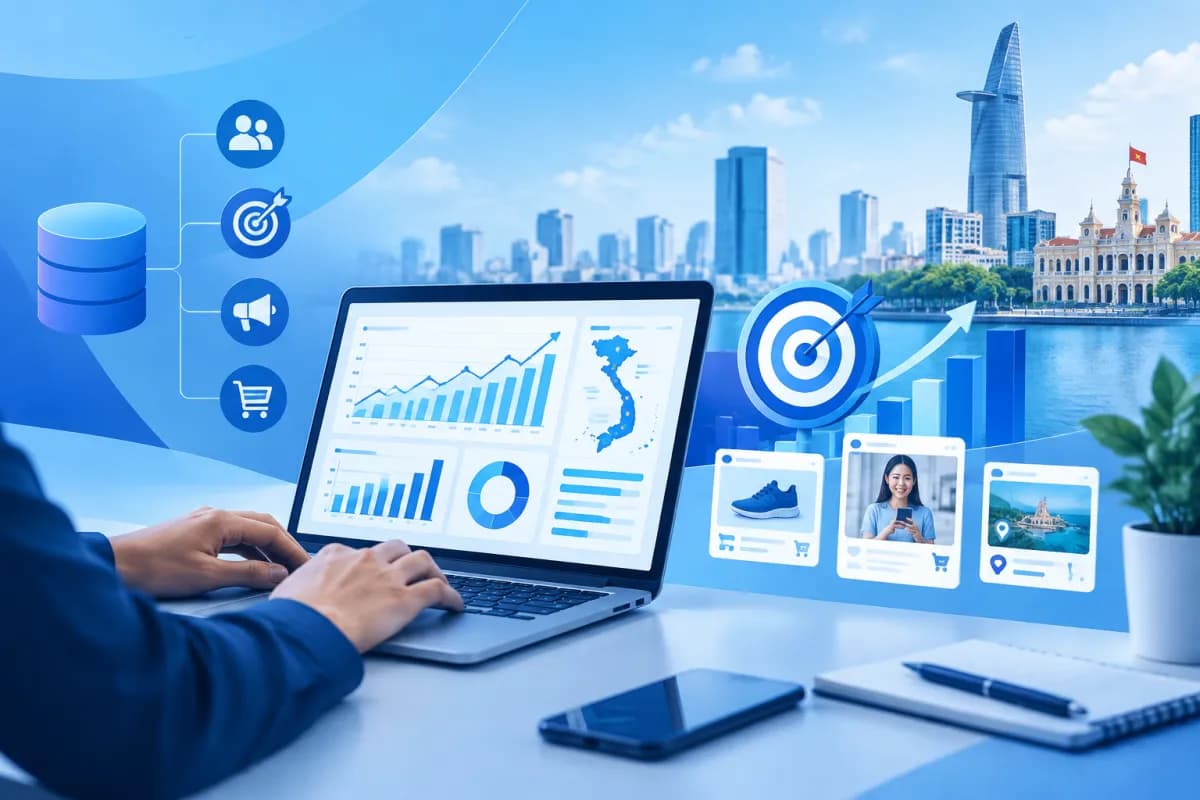
Today, customers leave behind a wealth of signals as they search, shop, and interact with brands. By collecting, connecting, and analyzing these signals, businesses can make marketing decisions that better reflect customer needs instead of relying on intuition alone. That is why more teams are asking what data-driven marketing in Vietnam looks like in practice.
Data-driven marketing is not just for large corporations with dedicated analytics teams. Small and medium-sized businesses in Vietnam can also get started with data they already have, such as order histories, website visits, social media feedback, or customer sign-up details. This article explains the concept, how to apply it, and practical examples to help you find an approach that works for your business.
What Is Data-Driven Marketing?
Data-driven marketing is an approach to planning, executing, and optimizing marketing activities based on data about customers, the market, and campaign performance. Rather than making assumptions about what customers care about, businesses observe actual behavior, identify groups with shared needs, and use that evidence to choose their messages, channels, and timing.

For example, a cosmetics store might notice that customers who buy sunscreen often look for advice on choosing products suited to their skin type. Using order data and popular content, the marketing team can create a series of advice articles, send related product recommendations, or adjust its advertising. This is different from broadcasting the same message to every customer.
The key point is that data does not create a strategy on its own. Businesses need to ask the right questions, set clear objectives, check data quality, and interpret findings in the context of their operations. A dashboard may show an increase in clicks, but further analysis is needed to determine whether those clicks generated leads or revenue.
What Data Should Businesses Collect?
Useful data does not have to be complicated. In the early stages, businesses should prioritize information directly related to the customer journey and business goals. Marketing data can be grouped into several categories:
- Transaction data: Products purchased, order value, purchase date, payment method, and repeat purchase frequency. This data can help identify new customers, loyal customers, and those who have not purchased in a while.
- Digital behavior data: Pages viewed, content read, search terms, in-app actions, products added to cart, and points where customers leave the purchase process.
- Engagement data: Email opens, message responses, comments, calls to customer service, and conversations with sales staff.
- Demographic and needs data: Location, age group, occupation, or interests voluntarily shared by customers. Collect only information that is genuinely necessary for the stated purpose.
- Campaign data: Budget, impressions, clicks, leads, orders, and the cost of each result.
Businesses can source data from sales systems, CRM software, websites, advertising platforms, email marketing tools, and customer service teams. However, it is important to check whether different systems identify the same customer consistently. Duplicate, incomplete, or outdated records can undermine the reliability of analysis.
How to Apply Data-Driven Marketing
To turn data into action, businesses can follow a clear process rather than collecting a large volume of information and leaving it unused. The steps below work for small teams too, as long as they choose a realistic initial scope.

- Set a business objective: Choose an outcome to improve, such as increasing the rate of visitors who submit their contact details, generating more revenue from existing customers, or reducing the cost of acquiring an order. Make the objective specific and time-bound.
- Decide what questions to answer: Which customer groups tend to buy again? At what point do visitors leave the site? Which content encourages people to request a consultation? Clear questions help determine what data is needed.
- Collect and standardize data: Agree on how to record lead sources, order statuses, campaign names, and contact details. Collect data only for a defined purpose, on an appropriate basis, and with proper safeguards.
- Analyze data to identify groups and opportunities: Compare behavior across groups, track drop-off points in the customer journey, and look for possible explanations. Avoid jumping to conclusions about causation based on a single metric changing.
- Create content and run tests: Develop messages for each group, test different content versions or channels, and measure the results using consistent criteria.
- Evaluate and adjust: Compare results with the objective, record lessons learned, and update the campaign. Repeating this process helps businesses improve continuously instead of treating the report as the final step.
For example, if the goal is to increase repeat purchases, the team could first determine the average time between orders. The business could then test sending usage tips, information about complementary products, or a relevant offer at a time when customers may be ready to buy again. Results should be compared with a similar group of customers who did not receive the message, so that other factors are not mistaken for the campaign's impact.
Real-World Examples in Vietnam: Segmentation and Personalization
Imagine a Vietnamese fashion store selling through its website, e-commerce marketplaces, and social media. Previously, the store sent the same discount offer to its entire customer list. After consolidating purchase histories and engagement data, the team identified several distinct groups: people who had only browsed products, customers who often bought office wear, customers interested in new arrivals, and customers who had not returned in a while.

The store can then create more relevant content for each group. New visitors can be introduced to best-selling collections and a guide to choosing the right size. Customers who buy office wear can receive outfit suggestions or recommendations for products in a similar style. Those who have not purchased in a while might be sent information about a new collection, but an offer should be used only if it is likely to motivate them. Recent buyers can receive product care instructions instead of being constantly urged to buy more.
Another example is an education business in Ho Chi Minh City advertising its courses. If data shows that visitors often view the curriculum, class schedule, and tuition fees but rarely submit a form, the business can check whether this information is easy to find or the form is too long. Follow-up content could answer common questions, explain study formats, or invite people to book a consultation. By analyzing lead sources, the business may also discover that a channel generating lots of visits does not necessarily bring in many suitable students.
In both cases, personalization does not mean using every piece of information to track customers. The goal is to make the experience more useful and relevant while respecting recipients' communication preferences. Content should provide value even when it does not include a sales pitch.
Measuring Results and Key Considerations
The metrics to track depend on the objective. For lead generation, businesses can look at the number of sign-ups, conversion rate, cost per lead, and the quality of sales opportunities. For online sales, common metrics include add-to-cart rate, order completion rate, average order value, and repeat purchase rate. For content, reading time or engagement can be useful, but these should be connected to the actions the business wants to drive.
Common mistakes include chasing too many metrics, treating engagement as equivalent to revenue, creating segments so small that they are costly to manage, or drawing conclusions too quickly from a short campaign. Businesses should choose a few key metrics, monitor trends over an appropriate period, and also review qualitative customer feedback.
Personal data must also be handled responsibly. Businesses should clearly explain why data is being collected, restrict access, maintain security procedures, and respect requests to update details or stop receiving communications. Complying with applicable data and privacy rules not only reduces risk but also helps build customer trust.
There is no need to invest in a large system right away. A business can start by standardizing sales data, setting up website analytics, and preparing regular campaign reports. As needs grow, it can connect a CRM, marketing automation platform, or ERP system to reduce manual data entry and support more comprehensive analysis.
Conclusion
What is data-driven marketing? It is an approach that uses quality data to understand customers, segment them by their needs, personalize content, and improve campaign performance. Its value lies not in the number of tools or reports, but in the ability to turn information into practical, measurable decisions that respect customers.
Start with a specific objective, make use of the data your business already has, and test an approach at a suitable scale before expanding it. If you need a measurable website, want to connect marketing data with your CRM or ERP, or are developing a digital growth strategy, contact LilyTech for advice on solutions suited to your business size and goals.

