
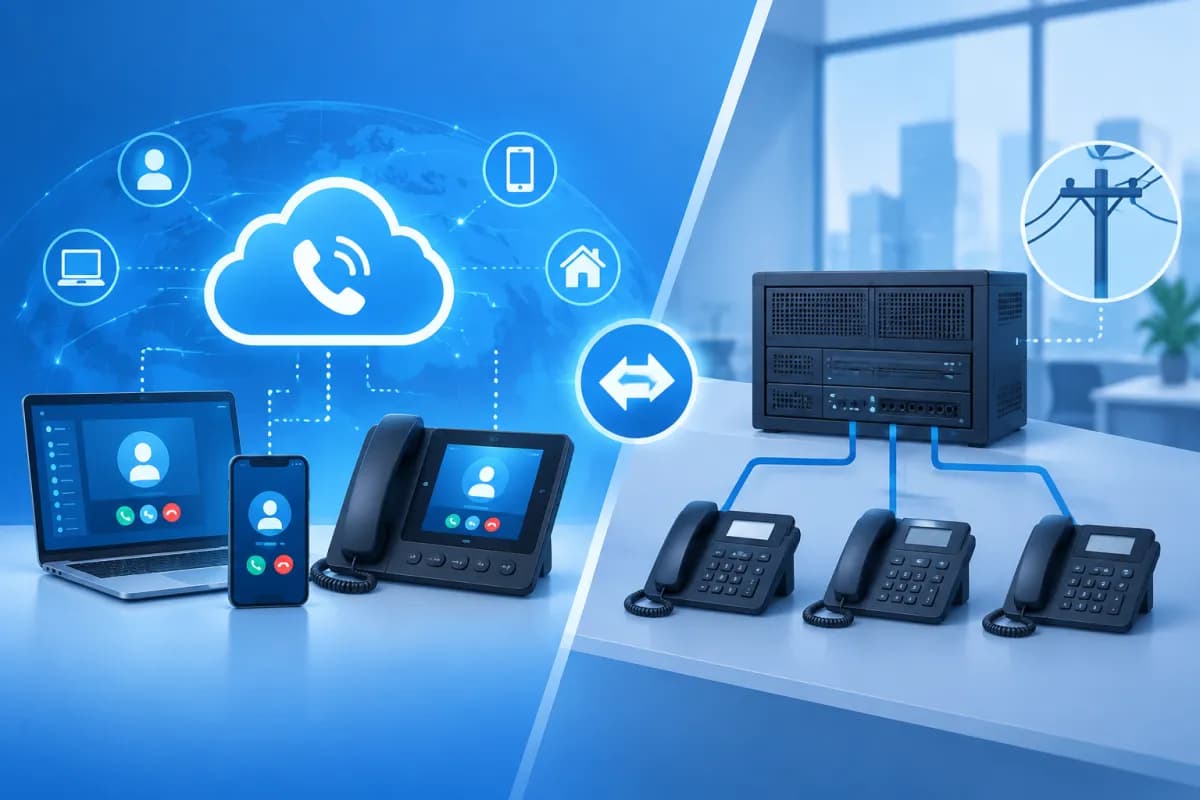
When a business needs to manage customer service calls, sales inquiries, or communications across multiple offices, a phone system plays an important role in day-to-day operations. VoIP is gaining attention because it uses the internet to transmit voice and connect employees flexibly.
So, what is VoIP, and how does a VoIP phone system differ from a traditional one? This article compares VoIP vs. traditional phone systems in terms of cost, features, scalability, and infrastructure requirements to help business owners choose a solution suited to their size and growth plans.
What Is VoIP? How Does a VoIP Phone System Work?
VoIP stands for Voice over Internet Protocol, a technology that transmits voice over the internet protocol. Rather than carrying voice signals over dedicated telephone networks, as traditional systems do, VoIP digitizes audio into data and sends it across an IP network, such as the internet or a company’s internal network.

A VoIP phone system is a call-management system built on this technology. Users can make and receive calls using IP phones, computers, mobile apps, or compatible adapters. Depending on the setup, the system can run on a company’s on-site servers, in the cloud, or through a combination of both.
At a basic level, the system typically includes phone-system software, endpoint devices, a network connection, and trunking services for connecting to the public telephone network. This allows employees to use extensions for internal calls, transfer calls, answer customer calls, and coordinate with colleagues at different locations.
It is important to note that VoIP does not mean every call is free. Costs depend on the service plan, number of users, calls to the telephone network, equipment, and deployment model. Call quality also depends significantly on the stability of the network connection.
Comparing the Costs of VoIP and Traditional Phone Systems
Traditional phone systems generally rely on telephone lines, wiring, and physical phone-system equipment at the office. Businesses may need to make an initial investment in the system, desk phones, cabling, and configuration. As the business grows, adding extensions or lines can incur additional equipment and installation costs.

With VoIP, upfront costs may be lower if the business already has an internet connection and compatible devices. Some cloud-based options charge a subscription per user or for a bundle of features, rather than requiring the business to purchase and maintain all the physical phone-system equipment itself. However, businesses should also account for setup fees, IP phones or headsets, call charges, and network upgrades if the existing infrastructure is not sufficient.
- Equipment costs: Traditional phone systems may require multiple specialized devices. VoIP can make use of computers or mobile phones, although the quality and user experience may differ from those of dedicated IP phones.
- Operating costs: Cloud-based VoIP often reduces the need to maintain on-site servers. Traditional systems may require staff or a service provider to perform regular equipment maintenance.
- Call costs: Charges depend on the carrier, provider, and type of call. Businesses should compare actual rates rather than assume one solution is always cheaper.
- Outage costs: Consider the risk of losing connectivity, backup arrangements, and how much the system depends on the internet or telephone lines.
For a fair comparison, estimate the total cost of ownership over several years, including upfront investment, subscriptions, call charges, maintenance, upgrades, and the cost of adding users. VoIP can make costs easier to scale for small businesses or those with many employees working flexibly. Businesses that have invested heavily in an existing system should assess migration costs before replacing it.
Differences in Features and Call Management
Traditional phone systems can support core needs such as internal calls, call transfers, call holds, and extension groups. Advanced features may also be available, depending on the equipment, version, and configuration, but changes often require an on-site technician or assistance from the provider.
VoIP phone systems typically offer a range of management features through a software interface. Depending on the service plan, businesses may have access to automated greetings, call-routing menus, call recording, queues, reports, voicemail, and call routing based on time or employee status. Some platforms also integrate with customer relationship management (CRM) systems and customer service tools.
These features help businesses track call volume, route calls to teams, and support quality management for customer consultations. For example, remote employees can log in to the system and receive calls according to their permissions. Managers can review reports to identify peak call times or assess how long customers are waiting.
However, having more features does not always lead to better results. Businesses should identify their specific needs: Do they need call recording? What level of CRM integration is required? How should calls be transferred, and who should be allowed to access the data? It is also worth checking the provider’s data retention, access control, and security policies, especially when recording conversations with customers.
Scalability and Infrastructure Requirements
Scalability is an important consideration for businesses that regularly hire, open new branches, or change their working model. With a traditional phone system, adding extensions may require more connection ports, wiring, or equipment with sufficient capacity. When an older system nears its limits, the business may need to upgrade the hardware or install a new phone system.

With VoIP, new accounts or extensions can usually be set up through software or the provider’s administration portal. New employees can use an app on a computer or phone, including when they are not working in the office. The exact level of flexibility depends on the service plan, user licenses, provider policies, and security configuration.
In return, VoIP requires a stable internal network and internet connection. Businesses should check bandwidth, latency, packet loss, and the network’s ability to prioritize voice traffic. If multiple simultaneous calls share a connection with file downloads or online meetings, call quality may suffer. Network equipment, Wi-Fi, and firewall configuration should also be reviewed.
Traditional phone systems rely primarily on telephone lines and dedicated phone equipment. Depending on the setup, they may continue to operate independently of the internet, but still require power and the relevant telecommunications services. With either model, businesses need a backup plan for power or connectivity outages, such as backup power, call forwarding, or an alternative communication channel.
Should You Choose a VoIP or Traditional Phone System?
There is no single option that suits every business. A VoIP phone system is often a good fit for organizations that need to scale quickly, have employees in multiple locations, want to manage calls through software, or need to integrate calling with digital workflows. It is especially worth considering if the network infrastructure is stable and the business wants the flexibility to add or remove accounts.
A traditional phone system may suit organizations that are operating reliably with their existing setup, have specific requirements for dedicated phone connections, or cannot depend on an internet connection. However, businesses should assess equipment condition, scalability, and maintenance costs to avoid maintaining a system that no longer meets their needs.
Before making a decision, businesses should take the following steps:
- Count current employees, extensions, and concurrent calls, then forecast demand for the next one to three years.
- List essential features, integration requirements, call-recording retention rules, and data-access permissions.
- Check the internet connection, internal network, endpoint devices, and backup arrangements in case of an incident.
- Ask providers for detailed quotes and clarify subscription fees, call charges, equipment costs, technical support, and service termination terms.
- Run a small-scale trial to test call quality and fit with real-world workflows before rolling out the system more broadly.
Conclusion
Understanding what VoIP is helps businesses assess the differences between internet-based phone systems and traditional telephone systems. VoIP offers flexibility, software-based management, and user scalability, while a traditional system may suit businesses that prefer their existing telephone infrastructure or want to limit their reliance on the internet. The decision should be based on total cost, feature requirements, network quality, and growth plans—not just the initial subscription price.
LilyTech works with businesses to advise on and implement technology solutions that fit their operations. Contact LilyTech to discuss your phone-system needs, infrastructure, and integration options, and develop a clear implementation plan aligned with your business goals.

