
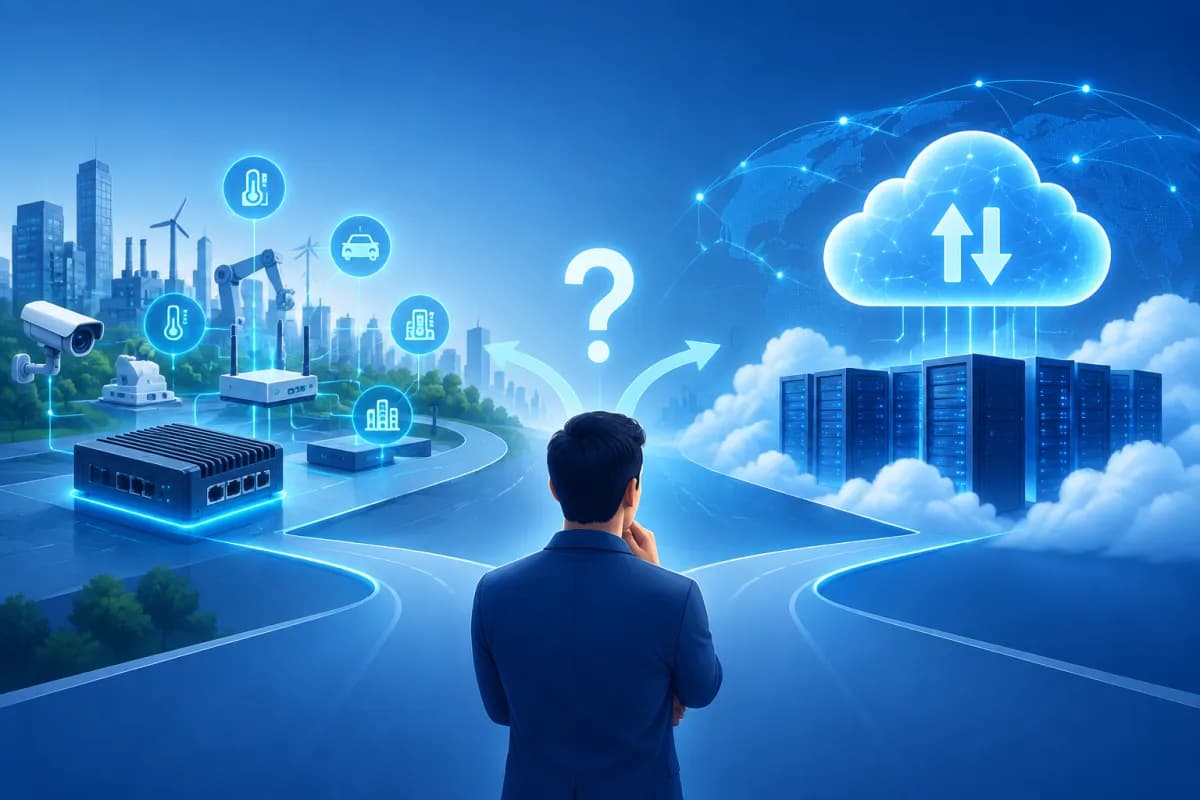
As data and applications play an increasingly important role in business operations, deciding where to process data can directly affect performance, costs, and customer experience. Two of the most widely discussed models are edge computing and cloud computing, but they solve different problems in different ways. Understanding edge computing vs cloud computing can help businesses make a more informed choice.
Edge computing processes data close to where it is generated, while cloud computing processes it on cloud infrastructure in data centers. This article compares the two models in terms of speed, cost, security, and use cases to help businesses choose the right approach—or combine both.
What are edge computing and cloud computing?
Edge computing is an approach that processes data at or near the devices, sensors, machines, or locations where it is generated. Instead of sending all the data to a remote cloud center, a system can analyze it and respond directly on an edge device, a factory server, or a local gateway.
For example, a store camera can analyze images on-site to detect incidents. Only alerts or data requiring deeper analysis are sent to the central system. This reduces reliance on a constant connection and limits the amount of data that needs to be transmitted.
Cloud computing provides resources such as servers, storage, and software over a network. Businesses can rent computing capacity from a cloud service provider rather than investing in all their own on-premises infrastructure. Resources are typically managed centrally, are easy to scale, and can be accessed from multiple locations.
The two models are not mutually exclusive. Many modern architectures use edge computing for tasks that require a quick response, while relying on the cloud for long-term storage, data aggregation, and training analytical models.
Comparing processing speed and latency
The most notable advantage of edge computing is its ability to reduce latency. Because data is processed close to where it originates, the system does not need to send requests across a network to a distant data center and wait for a response. This is useful for tasks that require an almost immediate response, especially when even a few seconds of delay can affect operations or the user experience.

In manufacturing, a monitoring system can detect unusual machine behavior and issue an alert on-site. In traffic management, field devices can process sensor data to adjust signals. In a store, an on-site system can continue to perform certain functions when the internet connection is unstable.
Cloud computing typically requires data to travel over a network before it is processed. Latency can therefore be higher, depending on the data center’s location, connection quality, and network traffic. However, for office applications, websites, business reports, and systems that do not require an immediate response, this latency is usually not a significant obstacle.
The cloud also has an advantage when it comes to centrally processing large workloads. Businesses can use powerful server clusters to aggregate data from multiple branches, run complex analytics, or serve fluctuating numbers of users. The choice therefore depends not only on the speed of each device, but also on the type of task involved.
Investment, operating, and scaling costs
Cloud computing often enables businesses to get started with a lower upfront investment. Instead of buying servers, building server rooms, and maintaining infrastructure themselves, businesses pay based on usage or a service plan. When demand grows, resources can be scaled up quickly; when demand falls, businesses can adjust capacity to avoid paying for resources they do not need.

However, cloud costs are not automatically lower in every situation. Storage, processing, data transfer, backups, and additional services can all add up. If a business continuously sends large amounts of data from multiple locations to the cloud, data transfer and processing costs can be significant. Monitoring usage and optimizing configurations are essential to keeping costs under control.
Edge computing can involve investment in edge devices, on-site servers, management software, and deployments across multiple locations. Businesses also need to account for maintenance, device replacement, system updates, and support staff. Managing a distributed setup can become more complex as the number of deployment sites grows.
On the other hand, processing data at the edge can reduce the amount of information sent to the cloud, helping to limit some network and storage costs. This model may be a good fit when data is generated continuously in large volumes, but only important results or events need to be retained. For a fair comparison, businesses should calculate the total cost of ownership over several years, including upfront investment, operations, connectivity, maintenance, and scalability.
Security, privacy, and reliability
Cloud computing enables businesses to centralize security policies, backups, and monitoring. Major providers typically invest in specialist teams, protection tools, and operational processes that many businesses would find difficult to build at the same scale. However, using the cloud does not mean that all risks are transferred to the provider. Businesses still need to manage access rights, service configurations, data encryption, and compliance responsibilities.
With edge computing, sensitive data can be processed on-site without leaving the premises. This gives businesses greater control over data flows and can help meet privacy or data storage requirements. Depending on how the system is designed, edge systems can also continue operating if their connection to the cloud is interrupted.
In return, every edge device or site can become a point that needs protection. Devices located in stores, factories, or hard-to-monitor areas may be vulnerable to unauthorized access, physical tampering, or delayed updates. With a distributed deployment, businesses need consistent processes for inventorying devices, applying patches, managing identities, and monitoring incidents.
With either model, security should be built in from the start rather than addressed after a system goes live. Businesses should classify data, limit access based on roles, encrypt data in transit and at rest, and establish backup and incident response plans. Specific legal requirements should also be assessed based on the industry and the types of data being processed.
Which model should businesses choose?
Cloud computing is often a good choice if a business needs to deploy quickly, serve users across multiple locations, scale flexibly, or avoid managing most of its own infrastructure. Management systems, collaboration tools, websites, e-commerce platforms, and aggregated data analytics can often benefit from the cloud’s centralized approach. When weighing edge computing vs cloud computing, start by matching each model to your business requirements.

Edge computing is worth considering when a business needs low latency, must process data where it is generated, wants to reduce its dependence on an internet connection, or needs to limit the transfer of large data volumes. Environments such as factories, stores, logistics operations, IoT devices, and monitoring systems may have a clear need for edge processing.
Before making a decision, businesses can work through the following questions:
- Speed: Does the system need to respond within a very short time?
- Connectivity: Does the operating location have a stable internet connection with enough bandwidth?
- Data: Is the data sensitive, large in volume, or required to be processed on-site?
- Cost: What are the total costs of devices, cloud services, data transfers, and operational staff?
- Management: Does the team have the expertise to monitor distributed infrastructure and secure devices?
- Scaling: Does the business expect to add locations, devices, or users in the future?
If tasks have different requirements, a hybrid architecture is often more practical than choosing a single model. For example, edge computing can process data that requires an immediate response at a factory, while the cloud stores results, provides dashboards, and analyzes trends across multiple sites. This division of work should be clearly designed, including data flows, operational responsibilities, and contingency plans.
Conclusion
There is no one-size-fits-all answer when businesses choose between edge computing and cloud computing. Edge is suited to tasks that require low latency, on-site operation, and control over data flows; the cloud stands out for centralized management, flexible scaling, and reducing the burden of building infrastructure in-house. An effective decision depends on business requirements, total cost of ownership, security needs, and actual operational capacity.
LilyTech can work with businesses to assess their needs, design websites and applications, advise on system integration, and develop a suitable technology roadmap. Contact LilyTech to discuss solutions that can optimize performance, costs, and long-term growth.

