
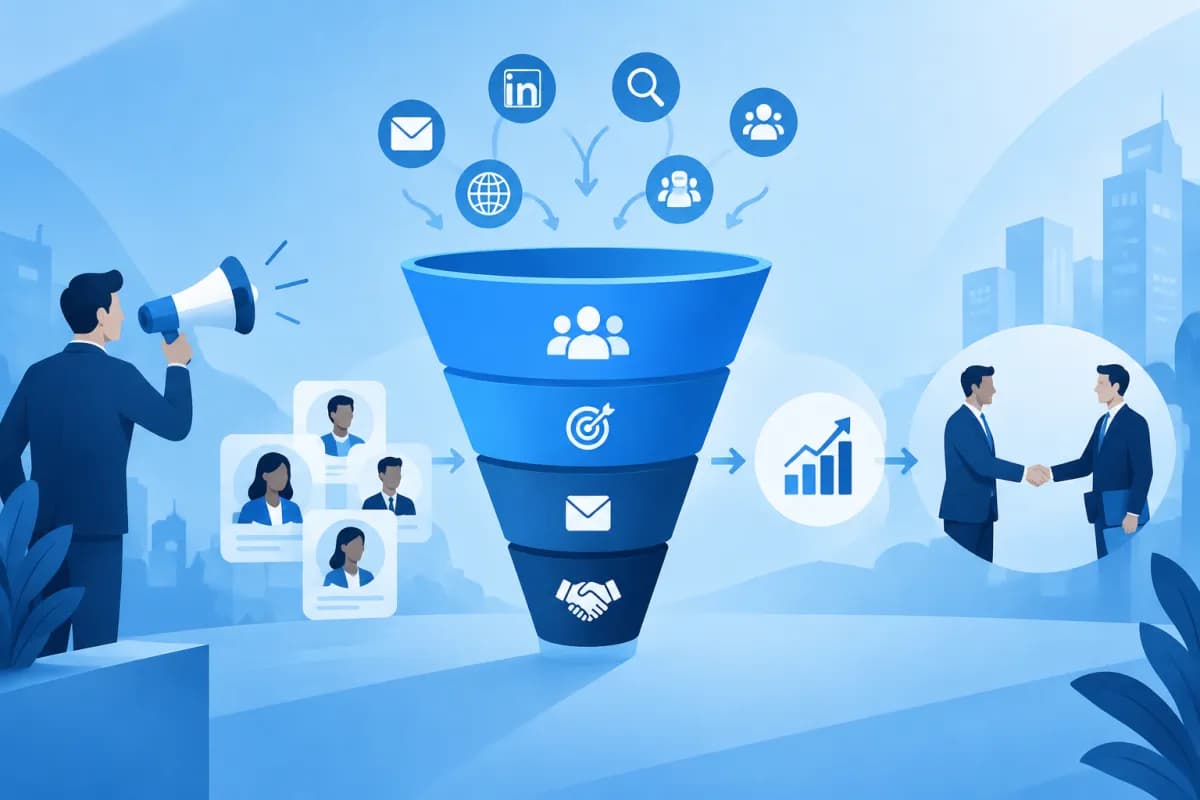
In B2B, customers rarely make a decision after seeing an ad or reading an article just once. They typically need to research solutions, compare providers, discuss budgets, and get buy-in from multiple departments. That is why businesses need a marketing funnel designed around the real buying journey, rather than focusing solely on generating more traffic or contact lists. A well-planned B2B marketing funnel helps guide prospects through this process.
An effective B2B marketing funnel connects marketing with sales, delivers the right content at each stage, and tracks signs of customer interest. This article explains how to build a funnel from awareness to conversion, taking into account long buying cycles and complex decision-making groups.
What Is a B2B Marketing Funnel, and Why Is It Essential?
A B2B marketing funnel describes how a business reaches and supports prospective customers from the moment they recognize a problem to the point when they evaluate solutions and are ready to buy. The funnel illustrates how the number of prospects typically decreases at each stage: many people become aware of a brand, fewer explore it in depth, and some of those prospects become customers.

Unlike many individual consumer purchases, B2B transactions often involve significant value, affect operational processes, and carry risks if the wrong choice is made. A deal can take months to close and may involve end users, managers, finance and technology teams, or senior leadership. Each stakeholder has different priorities: usability, integration, budget, security, or return on investment.
As a result, a marketing funnel does more than collect contact information. It should help businesses:
- Reach the right companies and the people who influence purchasing decisions.
- Provide useful information that helps customers understand their challenges and evaluate their options.
- Identify purchase readiness through customer behavior and direct conversations.
- Pass qualified opportunities to the sales team while staying in touch with prospects who are not yet ready.
Define Your Target Customers and Their Buying Journey
Before choosing promotional channels or creating content, businesses need to be clear about who they want to attract. A B2B target customer profile should go beyond industry or company size. Consider the company’s field, headcount, location, business model, current technology stack, and the challenges prompting it to seek a solution.

Next, identify the roles within the buying group. People who use a product directly may care about convenience, while managers focus on performance and senior leaders consider strategic impact. Finance teams typically need a basis for evaluating costs, while technical teams may assess integration and data security. Funnel content should address these different questions instead of focusing only on features.
Businesses can map the buying journey by interviewing existing customers and sales teams. Record what prompted customers to start researching, which information sources they trust, the obstacles they commonly face, and why they chose or rejected a provider. Then divide the journey into clear stages, such as awareness, consideration, and decision.
A good B2B marketing funnel starts with customer questions, not a list of content the business wants to promote.
Design a Marketing Funnel from Awareness to Conversion
Awareness stage: Attract the right audience
At the top of the funnel, customers may have just recognized a problem but not yet know how to solve it. Content should help them understand the context, symptoms, and impact of the problem. Businesses can publish in-depth articles, market research, webinars, explainer videos, or posts on channels relevant to their industry.

SEO attracts people actively searching for information; advertising can extend reach to specific target groups; and PR and professional activities help build credibility. Choose channels based on customer habits instead of trying to be everywhere. Messaging at this stage should be useful and easy to access, without asking for too much information before readers receive value.
Consideration stage: Nurture leads and build trust
Once customers understand the problem, they start looking for solutions and comparing options. This is the time to offer more in-depth content, such as guides, checklists, expert webinars, reports, comparisons of different approaches, or real-world implementation stories. Each piece of content should move customers one step further in their evaluation, rather than simply repeating a service introduction.
Businesses can invite readers to sign up for resources or events in exchange for their contact information. However, forms should be concise and proportionate to the value of the content. Then, send a series of relevant nurturing emails, segmented by industry, role, or interest. For example, if a customer downloads an ERP resource, follow-up content could explain how to evaluate processes, prepare data, and develop an implementation plan.
Decision stage: Reduce risk and support action
At the bottom of the funnel, customers need evidence to choose a provider. Offer case studies with clear context, details of the consultation process, service scope, implementation criteria, support options, and ways to measure results. Where appropriate, arrange a discovery call or a solution demonstration tailored to the company’s situation.
Calls to action should be specific, such as booking a consultation, requesting an assessment of current operations, or discussing project scope. Avoid pushing customers to buy too early; the goal is to clarify the next step and address concerns that could delay their decision.
Align Marketing and Sales Throughout Long Buying Cycles
A funnel works well only when marketing and sales agree on how to identify, assess, and handle leads. The two teams should align on terms such as lead, marketing-qualified lead, and sales opportunity. A contact who has just downloaded a resource may not be ready to speak with a salesperson; someone who has requested a consultation, on the other hand, may need a prompt response.
Businesses can develop qualification criteria based on two groups of signals: fit with the target customer profile and level of engagement. Job title, industry, and company size indicate fit; webinar attendance, consultation requests, and solution research show interest. Scoring should support initial screening, not replace reviewing the context and speaking directly with prospects.
Set up a clear handoff process: who follows up, the response time, what information needs to be recorded, and what to do when a prospect is not ready. If an opportunity is not yet qualified, marketing can continue nurturing it based on the prospect’s interests. If the sales team finds a contact is not a good fit, that feedback should be recorded to improve content and targeting criteria.
Measure, Optimize, and Avoid Common Mistakes
Do not evaluate a funnel solely by total traffic or the number of submitted forms. Choose metrics based on each stage’s goals. At the top of the funnel, track relevant traffic, engagement, and the sources bringing in well-matched prospects. In the middle, look at sign-ups, event attendance rates, email response rates, and the rate at which leads become qualified. At the bottom, track opportunities, conversion rates, time from first contact to deal, and revenue by source.
To optimize effectively, review data regularly and identify where customers drop out of the journey. If many people read content but few sign up, revisit the value proposition and call to action. If you have many contacts but few sales opportunities, review your target audience, messaging, and qualification criteria. With long buying cycles, analyzing results by customer segment and over an appropriate time frame is more useful than drawing conclusions from short-term fluctuations.
Common mistakes include creating the same content for every stage, measuring success by the number of contacts, sending frequent irrelevant emails, and letting marketing operate separately from sales. Many businesses also lack a process for updating data, leaving teams unaware of previous customer conversations. Start with a few priority segments, a straightforward process, and a consistent tracking system, then improve based on real-world feedback.
Conclusion: Build a Marketing Funnel That Fits Your B2B Business
An effective B2B marketing funnel reflects a long buying journey, multiple stakeholders, and the high level of trust required. Businesses should start by understanding their customers, creating content for each stage, aligning marketing closely with sales, and measuring results to make ongoing improvements. No single model fits every industry; a good funnel helps customers move closer to a decision and enables businesses to focus their resources where they matter most.
If your business wants to improve customer acquisition, develop digital content, or connect marketing with operational systems, LilyTech is ready to help. Contact LilyTech for advice on solutions tailored to your business goals, resources, and customers’ buying journey.

