
 Nguyễn Chính Ngọc Liên
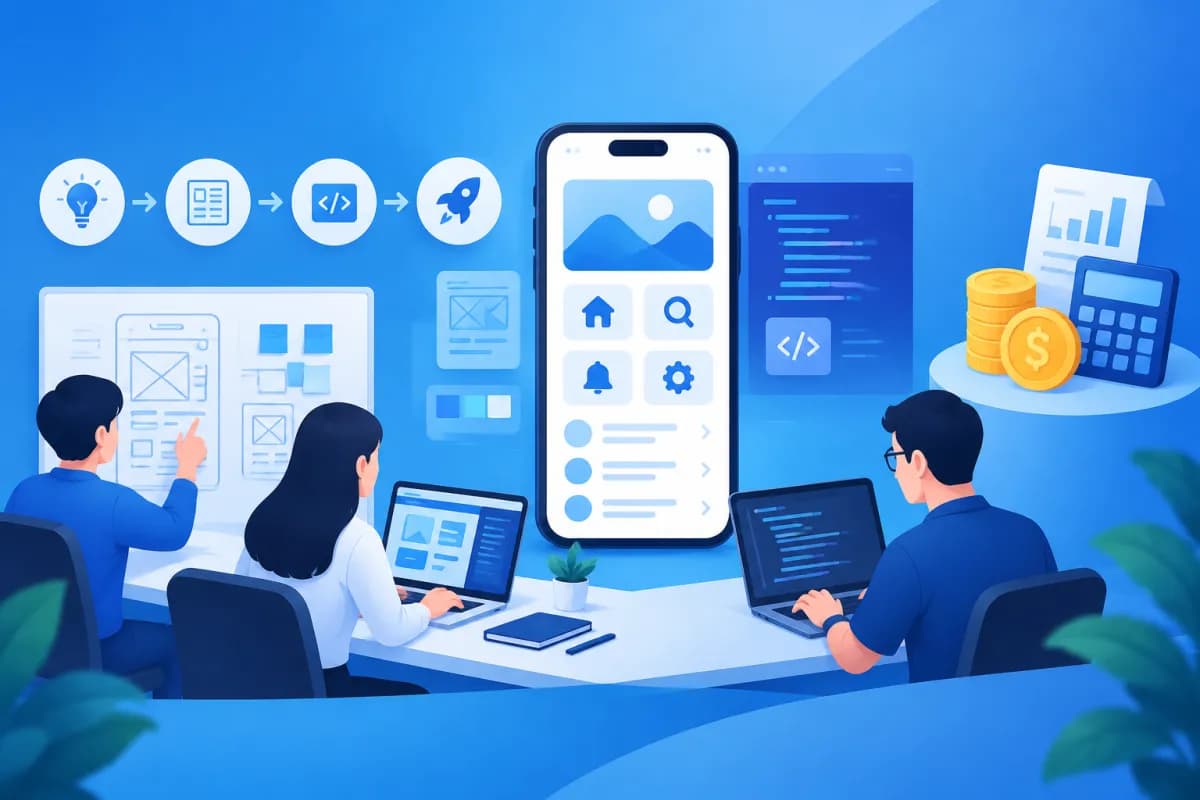
A mobile app can help businesses serve customers more conveniently, streamline internal processes, and create an additional sales channel. However, to ensure an app solves the right problems rather than simply looking good, businesses need to define their goals, users, and development scope from the outset.
This article explains the app design services process, the factors that affect costs, and how to prepare before working with a development partner. With this insight, businesses can make decisions that fit their budget, resources, and growth plans.
What do app design services include?
App design services typically involve a series of stages: requirements analysis, solution consulting, user experience design, development, testing, launch, and post-launch support. Depending on the provider and project scope, some items—such as building an admin system, integrating external software, or producing content—may be quoted separately.

Businesses should also distinguish between interface design and developing a complete application. The interface is what users see and interact with; an app also needs a technical architecture, database, business logic, security, and reliable operations. A successful project brings together an intuitive user experience and an appropriate technical foundation.
Before choosing a partner, clarify exactly what they will deliver. The scope might include an iOS app, an Android app, or both; source code; technical documentation; app store accounts; an admin system; and a warranty period. Agreeing on these details upfront helps avoid unexpected costs and provides a basis for assessing your return on investment.
The app design services process
Every project has its own requirements, but a transparent process typically includes the following steps. Ask your partner to explain the deliverables, owner, and approval process for each stage.

- Discovery and goal setting: The delivery team learns about the business model, user groups, problems to solve, and existing systems. Both parties agree on measurable goals, such as increasing orders through the app, reducing request-processing time, or improving customer retention.
- Requirements analysis and scope definition: Ideas are translated into a list of features, business workflows, and technical requirements. At this stage, the team determines what the first release needs to include, what can wait until a later phase, and what constraints apply to budget and timeline.
- UX and interface design: The design team develops user flows, screen layouts, and interface mockups. Businesses should ask target users or the teams who will operate the app to try the prototype, so confusing elements can be identified before development begins.
- App and related system development: Developers build the app, server, database, and admin portal according to the agreed scope. If the app needs to connect to payment services, maps, CRM, ERP, or other systems, those integrations should be designed and tested separately.
- Testing and acceptance: The product is tested across different devices, screen sizes, and usage scenarios. Areas to review include functional errors, speed, security, recovery from incidents, and data accuracy.
- Launch and improvement: After acceptance, the app is prepared for release on the appropriate app store or for internal deployment. Once it is live, the business tracks feedback and usage metrics to prioritize updates, bug fixes, and new features.
Timelines depend on complexity, how fully requirements are defined, and how quickly all parties respond. Delays in approving designs, supplying content, or providing integration accounts can affect delivery, even if the technical team has completed its work.
Factors that affect app design costs
There is no fixed price for app design services that applies to every business. A quote depends on the scope of work, technical requirements, and the level of post-launch support. Compare proposals based on their deliverables rather than looking only at the total price.

- Number and complexity of features: An app that presents basic information is usually simpler than one with user accounts, permissions, booking, order management, chat, notifications, and payments. The more business states and workflows a feature involves, the more time it takes to design, develop, and test.
- Deployment platforms: Building for iOS, Android, or both affects technology choices and testing effort. A cross-platform solution may suit some projects, but its performance, user experience, and integration requirements still need to be assessed individually.
- Interface and user experience design: The number of screens, degree of customization, and need for user research all affect cost. Investing in appropriate design can reduce unnecessary steps and avoid expensive changes after development is underway.
- Admin systems and integrations: Does the app need its own admin portal or connections to ERP, CRM, accounting software, payment gateways, or third-party services? Each integration involves data, access, and testing requirements, and may also incur provider fees.
- Security, performance, and scalability: Apps that handle sensitive data or high traffic need suitable solutions for permissions, storage, backups, monitoring, and system load. These requirements should be defined clearly rather than added only after problems arise.
- Testing, maintenance, and support: Device testing coverage, warranty duration, response times for issues, and upgrade pricing can all affect the total cost of ownership.
When reviewing a quote, ask which charges are one-time and which may recur, such as server costs, third-party services, app store accounts, or maintenance. You should also agree on how scope changes will be handled, since additions outside the original scope often increase both costs and timelines.
What should businesses prepare before app development?
Good preparation helps the delivery team understand the business problem and recommend a practical solution. Businesses do not need to have technical documentation ready, but they should provide clear business information and appoint an authorized contact to coordinate the project.
- Define goals and success metrics: Clarify whether the app is intended to generate revenue, improve service, or streamline operations. Choose relevant metrics, such as active users, transaction completion rates, or time spent processing work.
- Describe users and use cases: Who will use the app, where will they typically use it, and what challenges do they face? Consider both external customers and internal staff if the app serves multiple groups.
- Prioritize features: Categorize features as essential, important, or suitable for a later release. This helps focus on a viable first version, validate real-world demand, and then invest in expansion.
- Prepare content and data: Gather your logo, brand colors, product descriptions, images, policies, and required data early. If data needs to be migrated from an existing system, determine its format and quality and assign someone to review it.
- Appoint a project lead: The project lead should coordinate across departments, consolidate feedback, and respond on time. Agree on who can approve requirements, designs, and final acceptance to avoid conflicting feedback from multiple stakeholders.
- Plan the budget and operations: In addition to development, set aside funds for infrastructure, technical support, updates, and user acquisition. An app that launches without an operational plan will struggle to deliver long-term value.
Businesses should also prepare acceptance criteria from the beginning. For example, define the conditions under which each feature should work, which devices need to be supported, and how errors should be handled. Clear criteria help both parties evaluate the product fairly instead of relying on general impressions.
How to choose the right app design partner
The right partner does more than write code: they should understand the business challenge and collaborate effectively. When evaluating providers, consider their experience with similar projects, approach to requirements analysis, design capabilities, testing process, and post-handover support.
Ask them to explain their solution in plain language: why they chose a particular technology, how data will be managed, what the key risks are, and how upgrades will be handled. Request an itemized quote with acceptance milestones and payment terms to make progress easier to manage. If a proposal gives only a total price without a clearly defined scope, it will be difficult to compare providers meaningfully.
The contract should clearly state ownership of the source code and design assets, confidentiality responsibilities, warranty coverage, support duration, and the process for handling new requests. These details help businesses operate the app independently, even if they later need to change development teams.
Conclusion: Start with a clear plan to maximize your investment
App design services deliver value when a product starts with a specific need, has an appropriate scope, and is maintained after launch. Businesses should understand the process, assess all the factors that make up the cost, and prepare their goals, data, and project team before getting started. Rather than trying to fit every idea into the first release, prioritize the features that create clear value, then improve the app based on feedback and usage data.
LilyTech provides technology consulting and implementation services, supporting businesses from clarifying their needs through design and development to operational planning. Contact LilyTech for advice on app design services tailored to your business goals, budget, and growth plans.

