
 Nguyễn Chính Ngọc Liên
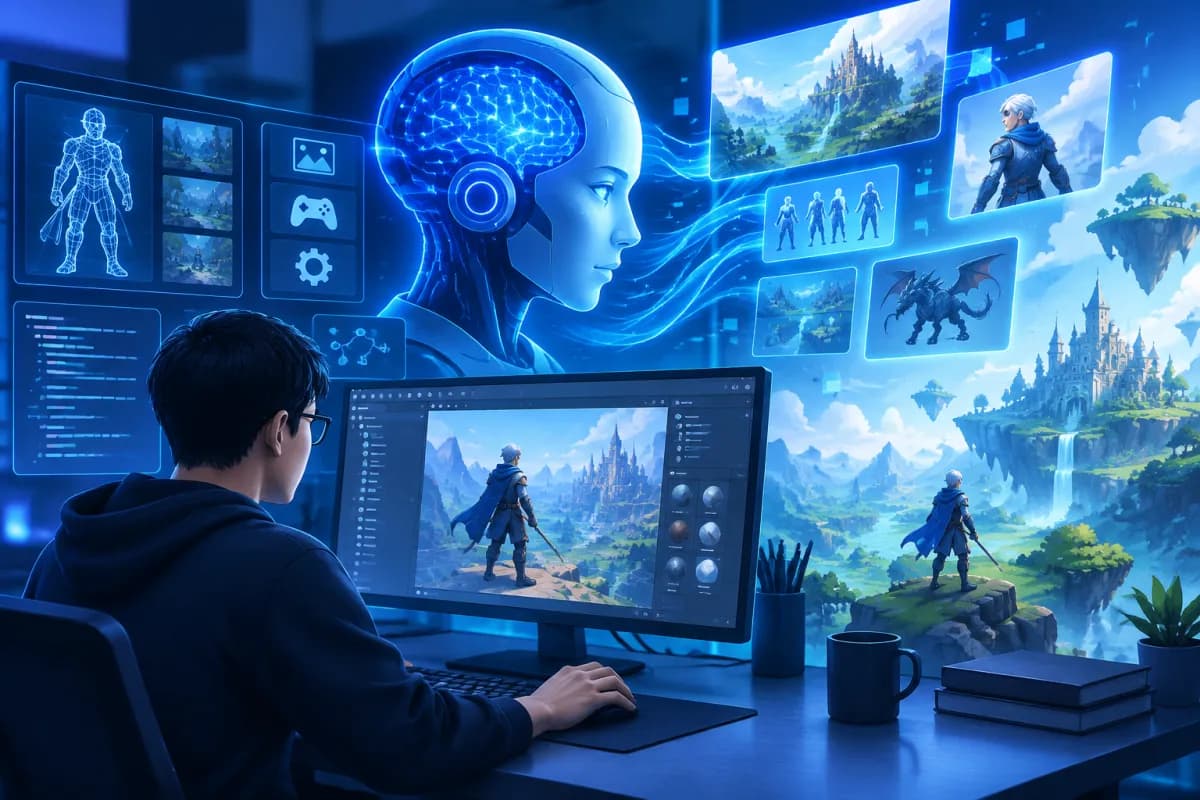
AI in game development is changing many stages of the process, from sketching characters to monitoring a game after launch. Artificial intelligence (AI) stands out for its ability to process data, automate repetitive tasks, and generate content on demand.
AI does not automatically turn an idea into a successful game. Its value lies in how development teams use it to test ideas faster, reduce manual work, and create experiences that better suit players. To use AI effectively, businesses need to understand where it can help, what its limitations are, and which decisions still require human judgment.
What role does AI play in new game technology?
AI in game development encompasses methods that enable software to recognize patterns, generate content, make predictions, or respond to input. Some applications have been around for a long time, such as controlling the behavior of non-player characters (NPCs). More recently, machine learning and generative AI tools have expanded their capabilities to include images, dialogue, audio, level design, and player behavior analysis.
What matters is not just the ability to generate content, but also the speed of experimentation. Instead of manually revising each option, developers can use AI to create multiple initial variations, evaluate them, and select the most suitable direction. AI can also process large amounts of playtesting data to identify anomalies or points where players drop out.
However, AI should be treated as a supporting tool within a process that has clear goals, data, and review steps. Without direction, a development team may produce a lot of content that lacks stylistic consistency, depth, or alignment with the experience the game aims to create.
Using AI to design characters and content
During pre-production, AI can help designers explore ideas for characters, settings, costumes, items, and visual styles. Based on a description or reference images, generative tools can produce multiple options for the team to choose from. This can shorten the initial sketching cycle, especially when exploring several creative directions before investing in a finished model.

AI can also help create NPC behavior and dialogue. Rather than repeating a handful of fixed lines, characters can respond more flexibly to the context, quest status, or the way a player interacts with them. For games with expansive worlds, this technology can make experiences feel more immersive and personalized.
Even so, AI-generated dialogue needs to be limited to what fits the game’s story and rules. Developers need to control tone, what characters are allowed to know, and sensitive content. If a character breaks the story’s continuity or makes an inappropriate statement, the experience can become inconsistent and damage the product’s reputation.
Idea development: Generate initial options for characters, items, and settings.
Experience adjustments: Test how NPCs respond to player choices.
Style control: Use visual and content guidelines to maintain consistency.
Building levels and adaptive content
Level design often takes multiple rounds of testing to balance difficulty, pacing, and rewards. AI can help generate layouts, terrain, side quests, or variations of an area based on rules set by the team. With procedural content generation, a system can combine pre-designed elements to create different levels.
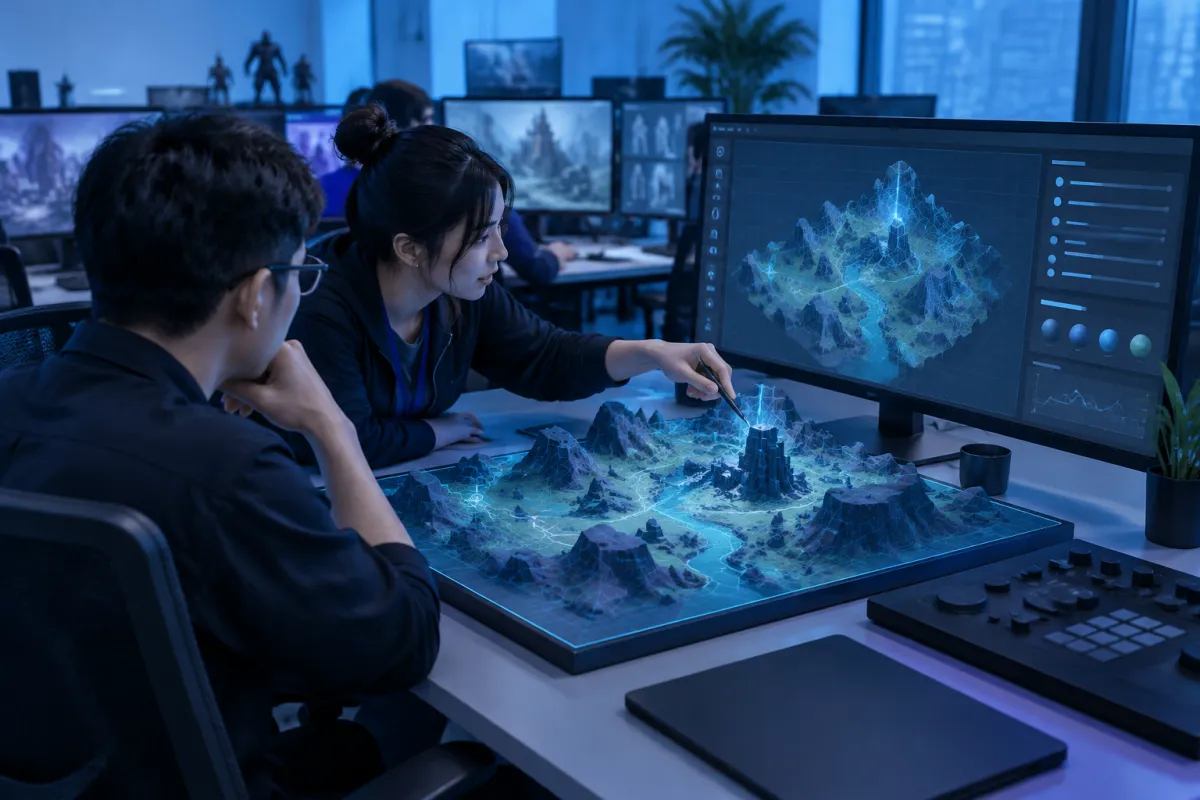
Another application is adapting challenges to player behavior. A system can detect when players are struggling, completing quests too quickly, or repeatedly using a particular strategy, then suggest changes to enemies, resources, or pacing. This approach can make the experience less monotonous, but it must be designed carefully so players do not feel the game is intervening unfairly.
AI does not replace the role of level designers. A map can be generated quickly and still lack memorable moments, narrative pacing, or a sense of discovery. Development teams should therefore set rules in advance, such as movement boundaries, the locations of key points, difficulty limits, and completion criteria. People can then assess whether the level is genuinely fun and serves the design goals.
Faster, more systematic game testing
Testing is one area where AI can deliver clear, practical benefits. Automated agents can repeat actions, move through different areas, test combinations of conditions, and find bugs that are difficult to reproduce through manual testing. This is useful for games with many levels, device configurations, or quest branches.

Analytics tools can also consolidate error logs, categorize feedback, and identify unusual patterns during gameplay. For example, a system might flag a quest with a high failure rate, an unusual completion time, or an area where many players get stuck. This helps the development team prioritize which issues to investigate instead of relying only on scattered feedback.
Despite its effectiveness, automated testing cannot fully replace real players. A machine agent can detect logic errors, but it cannot feel when pacing is dull, controls are frustrating, or a story moment has an emotional impact. A sound process typically combines automated testing, manual testing, and trials with target users.
Identify high-risk scenarios that need frequent testing.
Use automated agents to repeat actions and record reproducible bugs.
Compare the results with player feedback and the team’s assessment.
Retest after each update to prevent old bugs from reappearing.
Game operations and personalized experiences
After launch, AI can help operations teams monitor performance, detect cheating, and analyze in-game behavior. A system can identify unusual transaction patterns, activity that suggests the use of unauthorized tools, or a sudden increase in errors on a particular group of devices. Early detection helps teams prioritize a response before an issue affects more players.
In online games, data can show where players tend to stop, which content they use most, or which events bring them back. Operators can use these insights to adjust tutorials, balance items, and schedule events. AI can also help segment players to deliver more relevant notifications or recommendations, rather than sending the same content to everyone.
Personalization needs to go hand in hand with transparency and data protection. Businesses should collect only what they need, control access, and clearly explain how data will be used. Decisions involving accounts, transactions, or violations also need a review mechanism, rather than relying entirely on an automated result that could be wrong.
Limitations to consider when using AI
AI can produce incorrect, repetitive, or inconsistent output. Results depend heavily on training data, how prompts are written, and the review process. If AI-generated content is used without careful evaluation, a product may face issues involving quality, copyright, brand fit, or originality. Before using results in a commercial game, businesses should review the rights to the data and assets used as inputs.
Implementation costs also need to be considered. An AI solution may require infrastructure, data, technical expertise, and integration work. If it is adopted just because it is a trend, without addressing a specific problem, a project can incur costs without significantly improving efficiency. Before scaling up, teams should run a small pilot and define evaluation metrics, such as testing time, the number of bugs found, or player satisfaction.
Finally, AI cannot replace creativity, storytelling, or an understanding of users. The elements that give a game its identity still depend on the vision of designers and producers, as well as the player community. A good process clearly defines which tasks AI is allowed to perform, who is responsible for reviewing its output, and how to handle unwanted results.
Conclusion
New game technology powered by AI is helping development teams design characters, build levels, test, and operate games more efficiently. However, these benefits are sustainable only when AI is applied with the right goals and suitable data, and always paired with human review. Businesses should start with one specific area, measure the results, and then expand to other processes.
If your business is looking to apply technology to develop digital products or optimize operations, LilyTech is ready to help you find the right solution. Contact LilyTech to discuss your goals, resources, and an effective implementation roadmap.

