
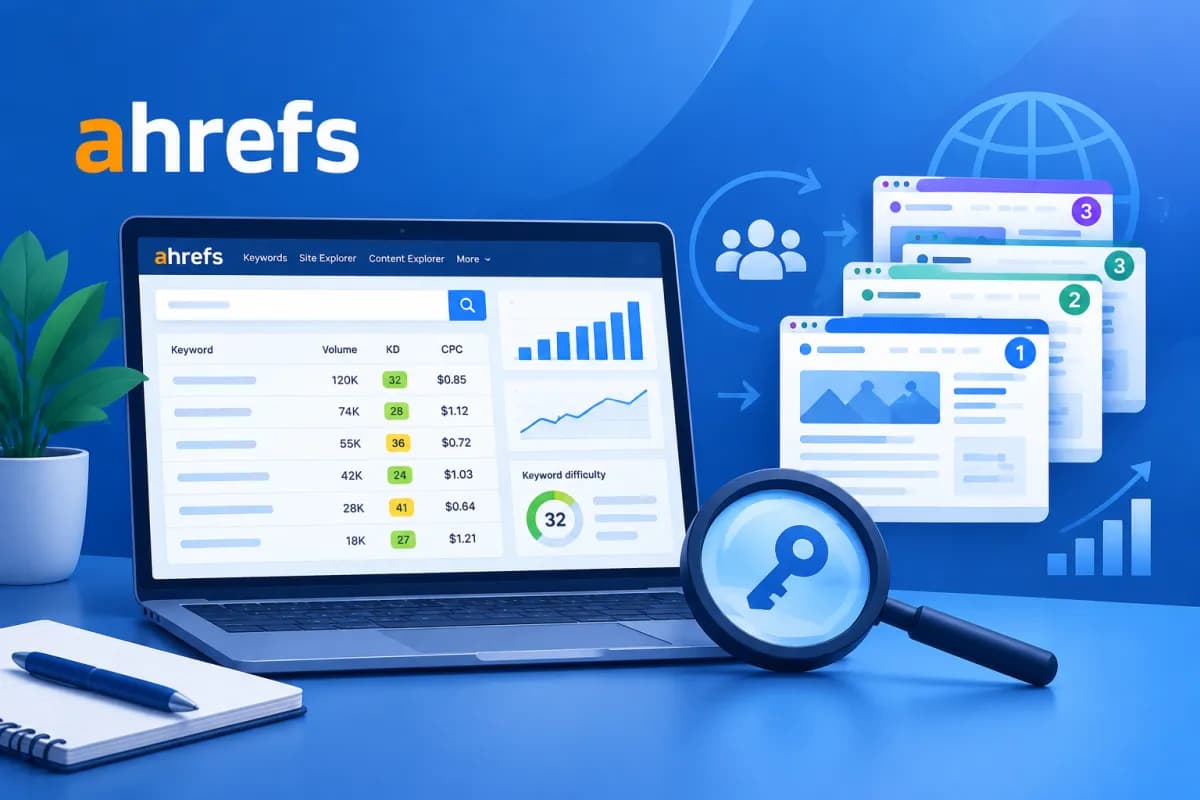
Building an effective SEO strategy means understanding not only what customers are searching for, but also which topics are driving traffic to competitors. The Ahrefs keyword research tool and competitor analysis help businesses review website search data, discover keywords competitors rank for, and evaluate untapped content opportunities.
However, tool data is only useful when interpreted correctly. This article explains how to use Ahrefs to analyze competitors, identify content gaps, and choose keywords that align with your business goals and resources.
What can the Ahrefs keyword research tool do?
Ahrefs is an SEO platform with features for keyword research, website analysis, and backlink profile monitoring. Site Explorer is commonly used to review the search performance of a website or specific page; Keywords Explorer helps users discover and assess keywords; and Content Gap compares keywords across your website and competitors’ sites.

When analyzing competitors, you can find out which queries their websites rank for, which pages bring in the most organic traffic, and which topics they cover frequently. These insights help marketing teams identify real search demand rather than choosing topics based on guesswork.
Keep in mind that Ahrefs metrics are estimates, not definitive reports on a website’s performance. Traffic, keyword rankings, and keyword difficulty may differ from the data in Google Search Console and Google Analytics. Use Ahrefs to discover and compare opportunities, then validate them against your own business data.
Choose the right competitors before analyzing them
Your analysis may be inaccurate if you include websites that are very different from your business. A brand may compete with you on products but not directly on content; conversely, an industry information site may compete for the same keywords even if it does not sell the same products.
Divide competitors into two groups to make comparisons more useful:
- Business competitors: companies that offer similar products or services and target the same customer segment.
- SEO competitors: websites that appear on Google for queries your business wants to reach, even if they do not sell the same products.
Start by searching Google for a few important product or service keywords. Note the websites that appear regularly, then review each one in Site Explorer. Prioritize competitors with relevant content, a similar target market, and a comparable website size so the comparison is meaningful.
Don’t choose only the biggest website in your industry. A site with thousands of content pages and a strong backlink profile may be too far ahead, making its opportunities difficult to act on. Include some mid-sized direct competitors to find topics your business can realistically compete for within a reasonable timeframe.
How to see which keywords your competitors rank for
Once you’ve identified your competitors’ websites, open Site Explorer and enter the domain you want to analyze. Depending on the interface and subscription plan, the names or locations of some reports may vary, but you’ll generally want to focus on Organic keywords and Top pages.

- Review organic keywords: Check the list of queries, estimated positions, search volumes, ranking pages, and estimated traffic. Focus on keywords relevant to customer needs rather than looking only at the total number of keywords.
- Filter by position: Filter for keywords ranking on or near the first page to identify content that is already gaining traction. Lower-ranking keywords may also be worth reviewing if the landing page is relevant and has room to improve.
- Review the landing page: Open the ranking URL to see whether the competitor addresses the query with a service page, category page, how-to guide, or product comparison page.
- Group by topic: Organize queries with the same search intent into groups, such as informational research, solution comparisons, or searches for a service provider.
The Top pages report gives you a content-focused view: it shows which pages contribute the most organic traffic and what topics they cover. Review the actual content to identify what makes each page valuable, such as step-by-step instructions, implementation examples, comparison tables, answers to common questions, or clear explanations of services.
Don’t mechanically copy competitors’ titles or content structures. The goal is to understand the needs their pages address, then create content that is more useful, accurate, and relevant to your products, expertise, and customers.
Use Content Gap to find content opportunities
Content Gap is a useful feature for comparing keywords across your website and competitors’ sites. Enter your website along with one or more competitor websites, then review queries for which competitors rank but your site has no visibility or ranks poorly.

To make the results easier to act on, choose competitors in the same topic area and apply relevant filters. You can filter by search volume, competitor ranking position, or the number of competitors ranking for a keyword. A keyword that appears across several competing websites may indicate real demand, but you should still check its relevance and whether your business can meet that demand.
As you review the list, ask yourself:
- Is the keyword related to a product, service, or problem your business addresses?
- Does the searcher want information, to compare options, or to contact a provider?
- Does your website already have a suitable page, or do you need to create new content?
- What questions are competitors answering that your current content leaves out?
A keyword gap doesn’t mean you need to publish a separate article for every query. Several similar keywords can be covered on the same page if they share search intent. Conversely, a query with a distinct intent may need its own page—for example, when users looking for guidance on choosing a solution have different needs from those requesting a quote.
Combine the data with a review of the content itself. A topic with low search volume may still generate high-quality leads if it closely relates to your services. Meanwhile, a high-volume but broad keyword may attract a lot of irrelevant traffic.
Prioritize keywords and turn insights into a plan
Once you have a list of opportunities, decide what to work on first. Don’t prioritize keywords based only on search volume or Ahrefs’ difficulty score. A practical assessment framework can include four factors: relevance to business goals, search intent, competitiveness, and available resources.
- Relevance: Will the topic attract the right target customers and support your core products or services?
- Search intent: Are users researching, evaluating options, or ready to get in touch?
- Competitiveness: How in-depth and authoritative is the top-ranking content, and how strong is its backlink profile?
- Resources: Does your business have the expertise, data, staff, and time to create better content?
Next, review your existing website before creating a new page. If you already have a related article, you may be able to update it, add missing answers, improve its structure, or clarify service information. Creating multiple pages that are too similar can cause them to compete with each other in search results.
For each topic group, create a plan that includes the primary keyword, related queries, search intent, proposed URL, content format, and the next action you want customers to take. For example, a how-to article can guide readers to a service page or consultation form, as long as the call to action is relevant and helpful.
After publishing, track rankings and performance over time, and compare them with Google Search Console, Google Analytics, and conversion data. If content gets impressions but few clicks, review the title and description. If it attracts visits but little engagement, assess the alignment between the content, readers’ needs, and the conversion journey.
Common mistakes to avoid when using Ahrefs
A common mistake is treating every metric in the tool as perfectly accurate. Estimated search volume and traffic are useful for relative comparisons, but they cannot replace your website’s own data. Businesses should also avoid choosing keywords solely because their difficulty score is low: real-world competition depends on content quality, website authority, search intent, and many other factors.
Don’t try to target every keyword your competitors rank for. Some topics may be unrelated to your services, outside your expertise, or unlikely to create business value. Likewise, don’t copy another website’s content, structure, or wording. Competitor analysis is for understanding opportunities and content standards—not a substitute for researching your own customers.
Finally, treat SEO as an ongoing process. Rankings can change, competitors can update their content, and search behavior can shift. Regularly reviewing the data helps businesses discover new topics, refresh pages that are losing effectiveness, and adjust their plans based on actual results.
Conclusion
The Ahrefs keyword research tool and competitor analysis help businesses better understand the queries competitors rank for, the pages that drive traffic, and the content gaps they can address. By combining Site Explorer, the organic keyword report, Top pages, and Content Gap with an assessment of search intent, businesses can turn SEO data into a practical content plan.
The key is to choose opportunities that fit your customers, business goals, and available resources rather than chasing every metric. If your business needs help with keyword research, SEO strategy, or content designed to support growth, contact LilyTech for advice on the right solution.

