
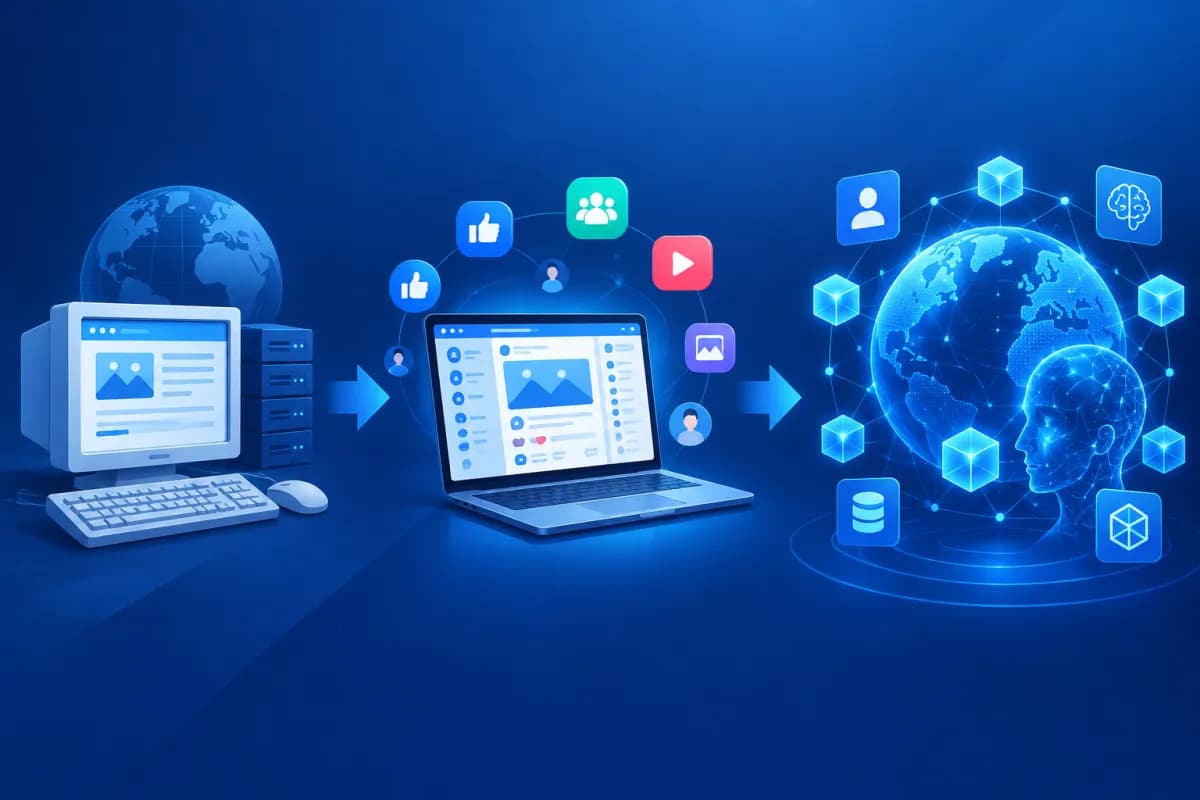
As the Internet has evolved from static information pages into interactive platforms and application ecosystems, the way businesses create content, manage data, and connect with customers has changed too. Recently, Web 3.0 has been discussed alongside blockchain, digital assets, smart contracts, and personal data control.
So, What is Web 3.0 technology? And how does this generation differ from Web 1.0 and Web 2.0? This article compares the three stages in terms of content creation, data storage, and the role of users, while outlining what businesses should consider before adopting the technology.
What Is Web 3.0 Technology?
Web 3.0 is a term for a direction in the Internet’s development in which applications can run on decentralized networks, using blockchain or similar technologies to record transactions and ownership. Users may interact with services through digital wallets, manage certain digital assets, and take part in how platforms operate. However, there is no single definition of Web 3.0 that all organizations agree on.

In common usage today, Web 3.0 is often associated with features such as:
- Decentralization: Application data or activity may be distributed across multiple network nodes, rather than depending entirely on a single server or provider.
- Blockchain and smart contracts: Some rules and transactions are recorded or executed automatically on a blockchain network.
- Digital ownership: Depending on how a service is designed, users may hold digital assets or credentials in an electronic wallet.
- Interoperability between applications: Assets or identities may be used across compatible services, although this depends on the standards and platforms involved.
It is important to distinguish this use of Web 3.0 from the concept of the Semantic Web, which has been used to describe a web where data is organized so computers can better understand its meaning. In practice, the two terms are sometimes conflated, but they are not entirely synonymous. Also, a service does not automatically become decentralized, secure, or beneficial to users just because it uses blockchain.
Comparing Web 1.0, Web 2.0, and Web 3.0
The three generations of the web can be understood as a shift from reading information, to interacting and creating content, and then to taking part in managing digital identities or assets. The points below summarize key differences across three criteria that matter to businesses.
- Web 1.0: Content was mainly published by website owners; users typically read information; data was stored on the operator’s servers.
- Web 2.0: Users both consume and create content; platforms provide interactive tools; data is often centralized with the businesses operating the services.
- Web 3.0: Users may take part in transactions, own digital assets, or contribute to networks; data and applications may use decentralized infrastructure, although the level of decentralization varies by project.
This is a general model, not a set of absolute boundaries. A modern website can combine technologies from different generations: a Web 2.0-style interactive interface, data on traditional servers, and a blockchain feature for transactions.
Differences in Content Creation and the Role of Users
Web 1.0: Users Primarily Consume Content
Web 1.0 is often described as a “read-only” web. Businesses, organizations, or individuals who owned websites published articles, product information, and static data. Visitors could view the content, but had few tools for commenting, sharing, or contributing directly. Early business websites often resembled online brochures, providing an address, service descriptions, and contact information.

In this model, editorial control rested largely with website owners. It was relatively straightforward to implement, but offered limited opportunities to build communities and gather feedback.
Web 2.0: Users Become Creators
Web 2.0 expanded interaction through social networks, forums, e-commerce platforms, and content-sharing services. Users can publish posts, comment, review products, livestream, and build communities. User-generated content has become an important part of the online experience.
For businesses, this creates opportunities to reach customers, gather feedback, and build a brand through content. In return, businesses often depend on intermediaries: distribution algorithms, advertising rules, data access, and account policies can change. Users can create content, but they do not necessarily control how the platform stores or uses that data.
Web 3.0: Toward Participation and Ownership
Web 3.0 adds an interaction layer related to ownership and verification. For example, users may connect a wallet to make transactions, hold digital collectibles, or vote in a token-based community. Some applications operate according to rules programmed into smart contracts.
Even so, digital ownership does not mean users own all their data or can freely move assets between every application. Actual rights depend on product design, terms of use, compatibility, and applicable laws. Businesses should clearly explain what rights users receive, what responsibilities they have, and what risks they may face.
Differences in Data Storage and Control
In Web 1.0 and most Web 2.0 services, data is typically stored on servers managed by the website owner or platform provider. This approach gives businesses control over their systems, access permissions, backups, and customer support. However, centralized data also means organizations must actively protect their systems against outages, attacks, and unauthorized access.
Web 3.0 may use blockchain or distributed storage networks. Rather than having a single organization record every transaction, multiple network nodes validate data according to the system’s rules. Blockchain records are generally difficult to alter once confirmed, which can make them easier to verify. However, on-chain data is not always suitable for storing personal information or sensitive business records.
Businesses should understand several limitations before implementation:
- Data cannot be easily deleted: The difficulty of altering records can conflict with requirements to manage, correct, or delete personal information.
- Security risks remain: Smart contracts, digital wallets, and users’ devices may contain vulnerabilities or be exploited.
- User experience and cost: Transaction fees, processing speeds, and wallet setup can create difficulties for mainstream customers.
- Governance responsibilities: If users lose their wallet keys, recovering assets can be complicated; organizations need to define how they will provide support.
The choice between centralized, decentralized, or hybrid storage should therefore be based on product objectives, data types, legal requirements, and operational capabilities. Putting data on a blockchain just because it is a trend can increase costs without solving a business problem.
When Should Businesses Adopt Web 3.0?
Web 3.0 may be a good fit when a business needs to improve transaction verification, build a membership program involving digital assets, connect a community, or coordinate multiple parties that do not fully trust one another. For example, a traceability system could record delivery milestones; a community project could test a voting mechanism; or a brand could issue digital collectibles tied to customer experiences.

By contrast, if the goal is simply to present services, receive consultation requests, sell online, or manage customers, a well-designed website and data system will often be more effective. Web 3.0 does not automatically replace existing web platforms, nor does it guarantee higher revenue or greater trust if the product does not meet users’ needs.
Before investing, businesses should answer these questions:
- What specific problem needs to be solved, and where are current technologies falling short?
- Do users really need digital wallets, digital assets, or blockchain-based verification?
- Which data can be public, and which needs to be secured or stored off-chain?
- Who is responsible for operations, user support, incident response, and regulatory compliance?
- Can the solution be tested on a small scale, measured, and expanded later?
A practical approach is to start with the customer journey and business objectives, then choose the technology. If you need to build a platform, focus on mobile experience, loading speed, security, integration, and data governance. For a Web 3.0 project, also assess wallet mechanisms, security keys, transaction fees, compatibility, and contingency plans.
Conclusion
In short, What is Web 3.0 technology? It can be understood as a direction in Internet development that places greater emphasis on decentralized networks, blockchain, and users’ ability to take part in managing digital identities or assets. Web 1.0 mainly enabled users to read content, Web 2.0 expanded interaction and creation, and Web 3.0 is exploring new models for ownership and verification. Each generation has its own benefits, limitations, and areas of application.
Businesses do not need to chase new technology without first identifying its practical value. LilyTech can advise on and implement website, mobile app, and digital system solutions that fit your business objectives, while helping you evaluate technology options before investing. Contact LilyTech to discuss your needs and a suitable implementation roadmap.

