
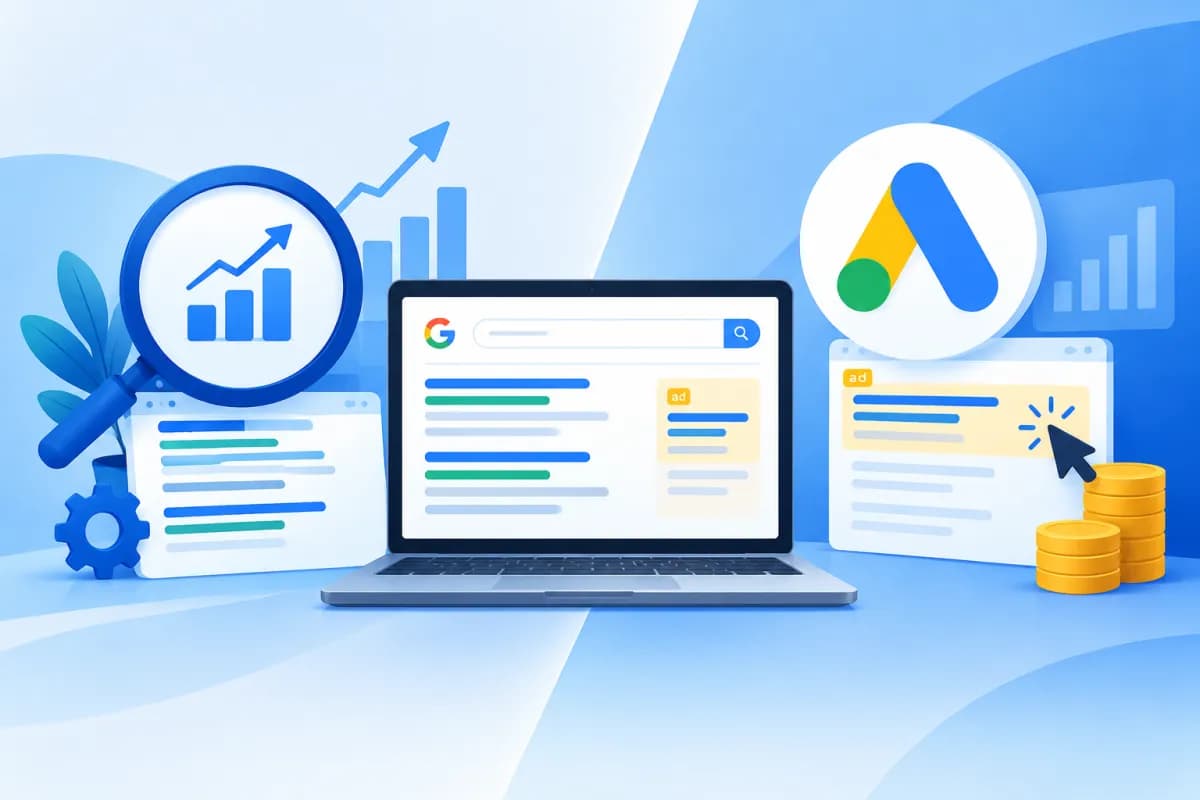
When businesses want to generate more leads from Google, they often weigh website optimization against paid advertising. Each channel works differently, requires a different level of investment, and takes a different amount of time to deliver results. Choosing the wrong one can mean your budget fails to deliver the value you expect.
So, what is website SEO, how does it differ from Google Ads, and which channel should your business prioritize? This article compares the two across three practical factors—cost, speed, and lasting impact—and explains how to combine them to meet your business goals.
What Is Website SEO?
Website SEO (Search Engine Optimization) is the process of improving a website so its pages have a better chance of appearing in relevant positions in organic search results. When people search for a product, service, or answer, a well-optimized website can reach them without paying for each click on an organic result.

SEO is more than adding keywords to content. It typically involves researching search needs, creating useful content, improving website structure and speed, optimizing the mobile experience, fixing technical issues, and building website authority. These elements need to work together and be maintained over time.
The goal of SEO is not simply to rank a few keywords highly. An effective strategy attracts the right people, helps them find the information they need, and makes it easy for them to take action—such as calling, filling out a form, or making a purchase. That is why businesses should assess traffic, lead quality, and conversions when measuring results.
How Are SEO and Google Ads Different?
Google advertising, commonly known as Google Ads, lets businesses pay to promote products or services in Google's ad placements. With search ads, businesses can target relevant queries and pay per click or use a configured bidding strategy. Once a campaign is eligible to serve, ads can appear quickly without waiting for the website to improve its organic rankings.
SEO focuses on organic visibility, while Google Ads focuses on paid ad delivery. Although their mechanics differ, both require keyword research, compelling landing pages, and conversion tracking. Clicks alone do not guarantee orders from ads, just as organic rankings do not mean customers will contact you immediately.
- SEO: Invests in website content, technical performance, and authority; results usually build over time.
- Google Ads: Uses an advertising budget to reach people quickly; delivery depends on budget, competition, campaign quality, and the landing page.
- What they have in common: Both require clear goals, accurate measurement, and ongoing optimization to turn traffic into business results.
In other words, SEO and Google Ads do not have to be mutually exclusive. Businesses can use Ads to test demand quickly while investing in SEO to build a long-term source of organic traffic.
Comparing Cost, Speed, and Lasting Impact
Cost: Paying for Clicks or Investing in a Foundation?
With Google Ads, businesses need to budget for ad spend and, if they hire an agency, campaign management and optimization. In competitive markets, the bid for a click can rise. When the budget runs out or a campaign is paused, ads typically stop serving. However, costs and performance can be tracked fairly directly through impressions, clicks, and conversions, provided measurement is set up properly.

SEO typically requires investment in research, content production, technical improvements, team capabilities, or an external partner. The cost is not necessarily calculated per visit, but that does not mean SEO is free. Businesses need time and resources to create quality content, improve their websites, and keep information up to date. Actual costs depend on competition, the website's current condition, keyword scope, and goals.
For this reason, do not compare only the cost of a click with the monthly cost of SEO. Consider the total cost of acquiring a qualified lead, the conversion rate, order value, and whether the value created can continue to be used. An Ads campaign may be expensive but still make sense for a high-margin product; an SEO project takes time but can become more cost-effective as the website attracts steady traffic.
Speed: When Do You Need Results?
Google Ads is often a good fit when a business needs to reach the market quickly—for example, when launching a product, running a short-term promotion, or testing interest in a service. Once the account, ads, targeting, and landing page are set up, a campaign can start generating traffic. Still, achieving strong performance requires testing messaging, keywords, and budget allocation.
SEO usually takes longer. A new website, one with a weak technical foundation, or one in a highly competitive industry may need an extended period for content to be indexed, rankings to improve, and trust to build. No provider can guarantee that a website will reach a specific position within a fixed timeframe, because rankings depend on many factors and change with competition and search engine updates.
If your business needs leads in the short term, Ads can deliver faster. If your goal is to build lasting discoverability, SEO is a long-term investment. In many cases, combining the two gives a business immediate visibility while laying the groundwork for the future.
Lasting Impact: What Happens When You Stop Investing?
One strength of SEO is that good content and an improved website foundation can continue attracting users after a page ranks. However, results are not permanent. Competitors may improve their content, search demand may change, technical issues may arise, or search algorithms may be updated. If you stop maintaining the site entirely, rankings and traffic may decline over time.
Google Ads typically generates traffic while a campaign is serving. When ad spend stops, visibility in ad placements also decreases or ends. Even so, campaign data remains useful: businesses can learn which queries show demand, which ad copy resonates, and which landing pages drive conversions—and apply those insights to future activities.
In short, SEO can build content assets and a source of traffic that accumulates over time, while Ads offers controlled reach for as long as a campaign runs. Both require optimization; the difference is how their value is built and maintained.
Which Channel Should Your Business Choose?
Do not base the decision solely on your available budget. Consider your goals, desired timeframe, profit margins, level of competition, and website quality. Here are a few scenarios to consider:

- Prioritize Google Ads if you need to test demand quickly, promote a seasonal campaign, introduce a new service, or meet a short-term sales target. Set a test budget, landing page, and conversion metrics before launching.
- Prioritize SEO if customers often research before buying, your business wants to build trust, and you have a long-term investment plan. Be ready to allocate resources to content, technical improvements, and ongoing measurement.
- Combine both channels if you need to generate demand now while reducing your long-term reliance on advertising. Search and conversion data from Ads can help inform SEO topics, keywords, and messaging.
Before launching, check that your website loads reliably, works well on mobile, explains your services clearly, and makes it easy to get in touch. Traffic is unlikely to produce results if visitors encounter a slow page, unconvincing content, or a complicated sign-up process.
Agree on the metrics to track as well: relevant visits, calls or form submissions, conversion rate, cost per lead, and recorded revenue. For SEO, also track organic visibility, keyword rankings by group, and the performance of individual pages. For Ads, monitor spend, actual search queries, lead quality, and profitability. Regular reviews help you adjust each channel based on data rather than instinct.
Conclusion
What is website SEO? It is the process of optimizing a website to reach people through organic search results and build lasting visibility. Compared with Google Ads, SEO generally takes longer but can build lasting value through content. Ads can reach people quickly but depend on an active budget. No channel is best for every business: the right choice depends on your goals, resources, and the timeframe for achieving results.
LilyTech provides website design, SEO consulting, and digital marketing services to help businesses build an online presence that supports their business goals. Contact LilyTech for advice on choosing and combining SEO with Google Ads—from website assessment to recommendations for implementation and performance measurement.

