
 Đoàn Lê Minh Anh
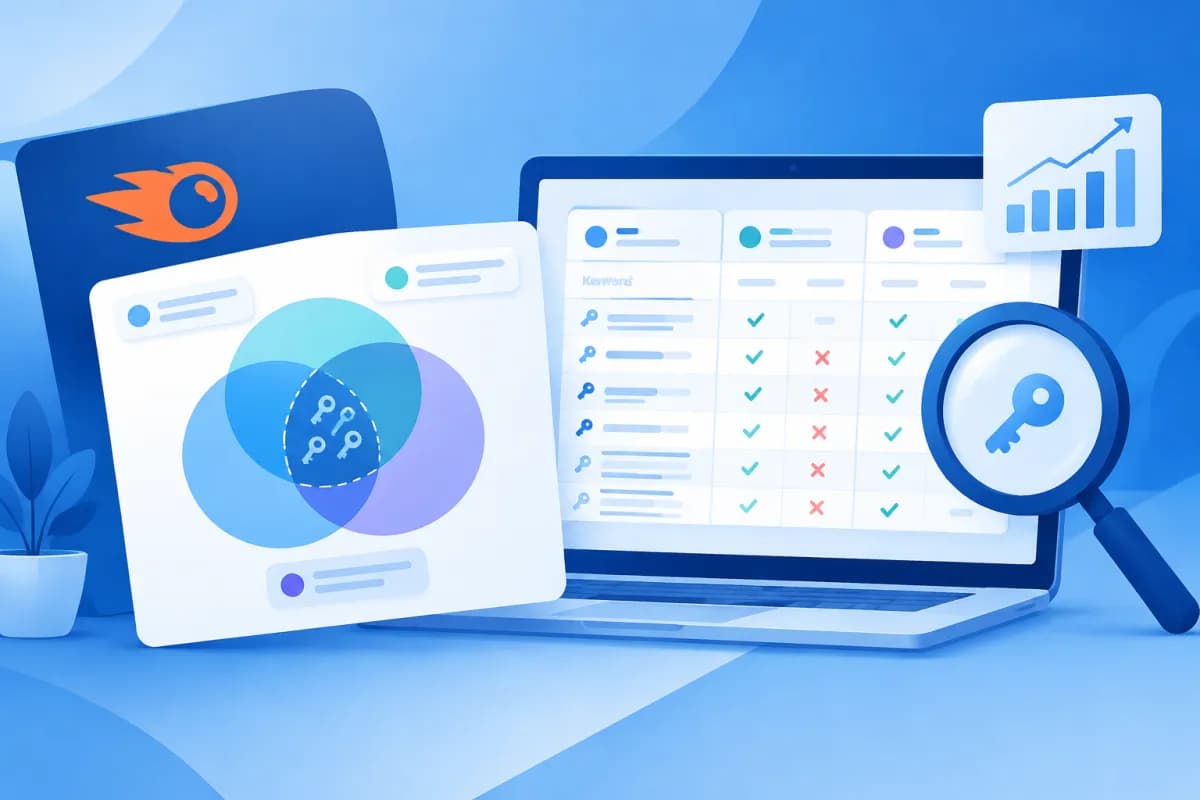
Your website may have plenty of content and still miss the queries potential customers are searching for. One way to uncover these gaps is to compare your keyword profile with those of your competitors. SEMrush Keyword Gap supports this process by showing which keywords competitors rank for, which ones your website has yet to target, and which areas may deserve priority.
However, a keyword list does not automatically become an effective SEO plan. Businesses need to know how to choose the right competitors, interpret different data groups, assess search intent, and turn findings into specific content or optimization actions. This article outlines a practical process for finding keyword opportunities that can support your growth goals.
What is SEMrush Keyword Gap, and how can it help?
SEMrush Keyword Gap is a keyword gap analysis tool in the Semrush ecosystem. It lets you compare multiple websites’ visibility in organic search results, paid search, or other supported search channels. Enter your business website and several competitors’ websites to see the terms each one ranks for and identify overlapping or missing keywords.

The tool’s value goes beyond finding more keywords. It helps answer strategic questions such as: Which topics are competitors using to attract customers? Which queries lack a suitable page on your website? And which content should you improve first? Combined with business data and customer insights, this analysis helps you build an SEO plan around real opportunities instead of choosing keywords solely for their search volume.
Keep in mind that data from SEO platforms is estimated, not a complete record of all search activity. Rankings can change over time based on location, device, and how the tool collects data. Treat the results as signals to investigate further, then validate them with Search Console data, website analytics, and information from your sales team.
What to prepare before comparing keywords
The quality of your analysis depends largely on choosing the right comparison scope. Before opening the tool, define your target market, language, location, and the type of search you want to study. A business selling in Vietnam should avoid drawing conclusions from data for a foreign market if search behavior and needs differ. You should also select the right website version, such as the main domain or a specific directory.

Next, select competitors based on how they compete in search—not just from a list of direct business rivals. You can group them into three types:
- Direct competitors: Businesses that offer similar products or services and target the same customer group.
- Content competitors: Information sites, blogs, or publishers that rank for topics your business wants to reach.
- Niche competitors: Smaller brands with in-depth content about a particular product, location, or market segment.
Do not enter only the best-known brands. Very large websites may rank for hundreds of thousands of keywords that have little relevance to your business’s size and resources. Start with a few websites that have similar content and target customers, then expand the list if needed. Before comparing, check that the websites operate in the same market and language.
How to use SEMrush Keyword Gap to find opportunities
The basic process is to enter your business domain and those of your competitors, select the right data scope, and run the report. The interface may vary by version or subscription plan, but the general principle is to analyze keyword lists, overlap, rankings, and which queries each website appears to be targeting. Record your search settings so you can make consistent comparisons later.

Once you have the report, sort opportunities into categories rather than treating the entire list as one:
- Missing keywords: Competitors rank for these, while your website has little or no visibility. This group is often useful for finding topics or needs you have yet to address.
- Weak keywords: Your website appears in search results but ranks below competitors. You may need to improve the content, page structure, internal links, or credibility.
- Shared keywords: Multiple websites compete for these terms. They help you assess your position and find ways to create more useful, distinctive content.
- Unique keywords: Your website has visibility for these terms, but competitors do not. This is an asset to protect and develop further.
Then use filters to narrow the list by ranking position, search volume, keyword difficulty, or other available metrics. Do not apply the same threshold to every industry. A new website may focus on specific queries with moderate competition, while an established brand can consider broader topics. Check each result on the search engine results page to understand the content being prioritized and how relevant it is to your business.
Evaluate and prioritize promising keywords
A keyword is not worth targeting simply because it has high search volume. First, determine its search intent: does the user want information, to compare solutions, find a provider, or complete a transaction? If the results page mainly shows guides, a direct sales page may not meet the user’s needs. Conversely, if searchers are comparing services, a general informational article may not do enough to support conversion.

Next, assess how relevant the topic is to your products, services, and capabilities. A topic with many searches but outside your area of service may bring in unhelpful traffic. Also consider the business value of the query group, the level of competition, its fit with the customer journey, and the resources required to create quality content.
You can use a simple scoring framework to rank opportunities. Score each factor from low to high: relevance, conversion potential, competitiveness, and data reliability. Opportunities that suit your customers and can be served by your actual products should take priority over keywords chosen only for their search volume. This approach helps the marketing team explain why a topic was selected and reduces decisions based on gut feeling.
Do not overlook specific, long-tail queries. They often reveal clearer needs—for example, when users describe the type of solution, business size, or situation they face. Although each query may have a low search volume on its own, several related queries can form a valuable content cluster. Group keywords with the same intent on one suitable page instead of creating multiple similar articles that compete with one another.
Turn data into a content plan and SEO improvements
Once you have chosen an opportunity, decide whether to create a new landing page or improve an existing one. If your website already has a related article, check whether it answers the right questions, provides up-to-date information, demonstrates expertise, and offers relevant navigation. If there is no suitable page, build an outline around real search needs, add a distinctive perspective, and link to product or service pages where helpful. Avoid copying a competitor’s structure or content simply because they rank well.

A strong implementation plan should specify the primary keyword, supporting query group, search intent, target reader, page format, owner, and deadline. It should also define the metrics to track: rankings, impressions, clicks, on-page behavior, and relevant conversions. Not every piece of content will generate leads immediately; some articles help build awareness or guide users to the next step.
Think of gap analysis as an ongoing process. After publishing or optimizing content, track results over a sufficient period, review changes, and update the content as search needs evolve. If your website does not improve, investigate the cause instead of simply publishing more articles: Does the page match search intent? Is the content useful enough? Is the site structure easy to navigate? Does the page have appropriate internal links?
Throughout this process, LilyTech can help businesses connect keyword research with content strategy, website design, and conversion goals. An effective approach turns data into clear priorities while ensuring each piece of content serves a specific customer need.
Conclusion
SEMrush Keyword Gap helps businesses see which topics competitors are targeting and which opportunities their websites have yet to address. The findings are valuable only when analyzed in the context of the right market, competitors, search intent, and business goals. Start with a relevant group of competitors, filter the results by relevance, and turn the best opportunities into a measurable content plan.
If your business needs to build a keyword research process, optimize its website, or connect SEO with broader marketing activities, contact LilyTech for advice on a solution tailored to your resources and growth goals.

