
 Nguyễn Chính Ngọc Liên
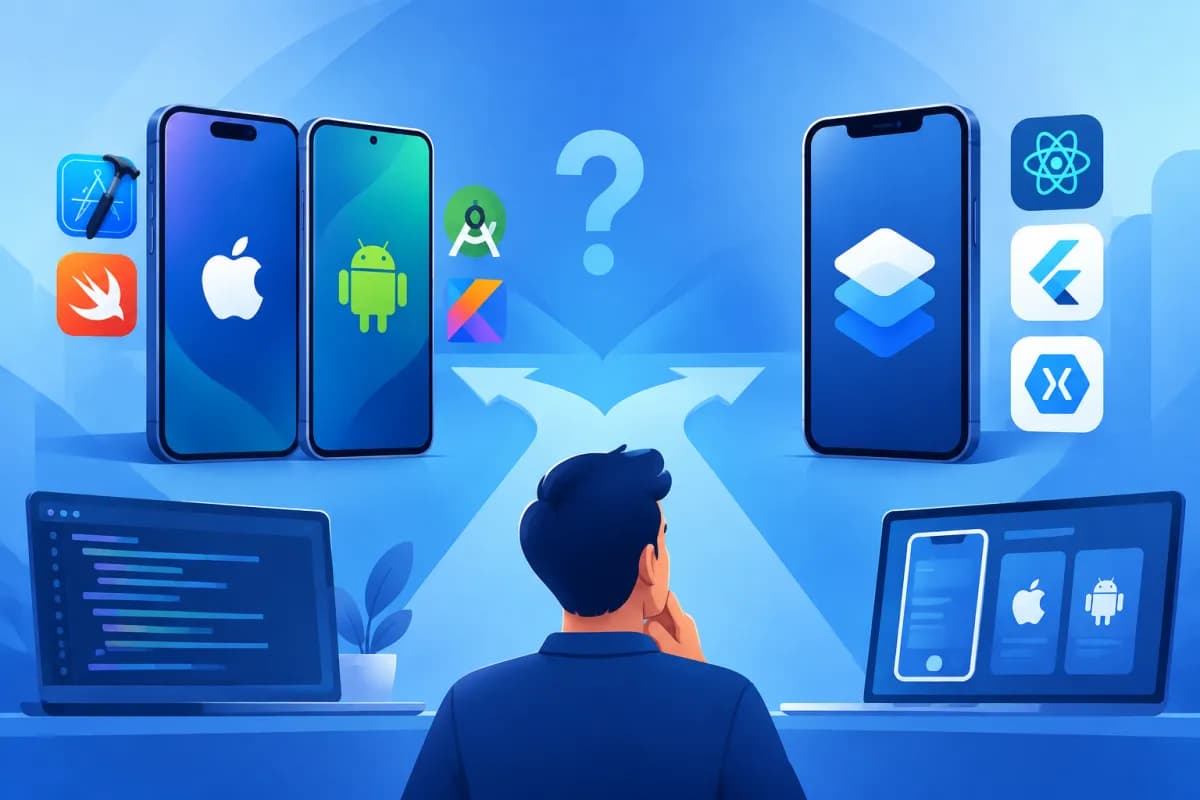
When planning iOS and Android app development, businesses often have to choose between two main approaches: building a separate native app for each operating system or using cross-platform technology to develop from a shared codebase. Each option has its own advantages, limitations, and investment requirements. The right choice depends not only on upfront costs, but also on user experience, time to market, and plans for future growth.
This article offers a practical comparison of the two approaches, helping business owners and marketing teams identify the right app development strategy for their product goals, resources, and growth expectations.
What are native and cross-platform app development?
Native app development means building a separate app for each operating system using its corresponding programming languages and tools. For example, iOS apps are typically developed with Swift or Objective-C, while Android apps use Kotlin or Java. The two versions may share the same concept and some design elements, but they are essentially built, tested, and released separately.

By contrast, cross-platform app development uses one codebase, or shares most of the code, to create versions that run on both iOS and Android. Technologies such as Flutter and React Native help teams build interfaces and features for multiple platforms without creating every component from scratch twice. However, some apps still require native code to support device-specific features.
The key difference is not simply “one codebase versus two.” Businesses should consider the level of customization, access to operating system features, team structure, and long-term maintenance costs. The same approach may work well for a simple appointment-booking app, but may not be ideal for a product involving complex graphics or data processing.
Pros and cons of native app development
Advantages: a tailored experience and deeper access to device features
Native apps are designed around the characteristics of each operating system, from navigation and notifications to interface components. This allows businesses to create an experience that feels familiar to iOS or Android users and fine-tune details for each customer group. This is an important advantage for products where interaction quality directly affects usage or revenue.
Native development is also often a good fit when an app needs deep access to hardware and system services such as the camera, Bluetooth, location services, biometrics, push notifications, or graphics processing. Teams can work directly with Apple’s and Google’s latest tools while gaining greater control over app behavior on each platform.
Limitations: separate investment and operations
Since each operating system typically requires a separate development track, businesses may need to allocate staff, testing time, and release processes for both versions. A feature update may also need to be implemented twice, increasing total development and maintenance costs. With limited budgets or teams, maintaining a consistent pace of improvement across iOS and Android can be challenging.
Native does not mean an app is always better in every situation. If a product only needs common features, the investment in two separate apps may not deliver proportional value. Businesses should weigh the benefits of deeper optimization against the additional cost and time.
Pros and cons of cross-platform app development
Advantages: faster launches and more efficient use of resources
With most of the code shared, teams can build and update apps for iOS and Android through a more unified process. This approach often reduces initial development time, avoids duplicated work, and helps businesses get their first version to market sooner. It is an advantage when testing an idea, validating demand, or launching a product with a limited budget.
Cross-platform development is also convenient when the interface and features need to remain consistent across both versions. Teams can focus on a shared development roadmap, reducing the risk that one operating system receives updates much earlier than the other. For many businesses, this makes planning and coordination across product, design, and engineering teams simpler.
Limitations: not every feature is easy to share
Some features that depend heavily on an operating system or hardware may require custom code, additional libraries, or platform-specific adjustments. Cross-platform development therefore does not mean that every cost is cut in half. If the initial architecture is poorly designed, custom components can make bug fixes, upgrades, and new features more complex.
Performance and flexibility should also be assessed in light of the product’s specific requirements. Modern frameworks can handle many common needs, but apps involving real-time processing, intensive graphics, or deep system interactions should be evaluated through technical testing. Businesses should test on real devices rather than relying only on demos or assumptions about the technology.
Compare options by budget, goals, and product lifecycle
To choose an app development approach, businesses should assess both options in the context of their product. A simple comparison of key criteria can help stakeholders align before planning begins:

- Initial budget: Cross-platform development is worth considering when a business needs to bring a product to market with a lean team and limited resources. Native development suits businesses prepared to invest separately in optimizing the experience or features for each operating system.
- Time to market: If you need to validate the market early, a cross-platform app may shorten the implementation process. If each platform requires a distinct experience, allow time for separate design and testing.
- Feature complexity: Content apps, basic e-commerce, appointment booking, and account management can often be built cross-platform. Products that rely heavily on hardware, graphics, or operating system APIs should be assessed for native development.
- User experience: If platform-specific user behaviors and interface conventions are a competitive factor, native development offers more room for customization. Cross-platform apps can still deliver a strong experience, provided the design is tested on each platform.
- Growth plans: Consider the cost of maintenance, operating system updates, new features, and team expansion after launch. A low initial cost does not necessarily mean a lower total cost of ownership.
A practical approach is to build a minimum viable product (MVP) with a clearly defined feature set, then measure usage and gather feedback. If requirements are not yet complex, cross-platform development can help validate assumptions quickly. When the data shows that a particular feature needs deeper optimization, a business can invest in native development for that feature rather than converting the entire app from the outset.
How to choose the right app development approach
Before making a decision, businesses should clearly define their target users, the problem the app will solve, and the most important action users should take. Next, list the features and distinguish essential ones from those that can be introduced later. This helps avoid overinvesting in an app whose scope has not yet been validated.

Next, assess key technical requirements: Does the app need to run reliably with a poor network connection? Will it use the camera or Bluetooth frequently? Does it process data in real time or integrate with internal systems? These requirements affect not only the technology choice but also the backend architecture, security, and testing process.
Businesses should also ask the development team to explain the total lifecycle cost, including design, development, testing, release, maintenance, and upgrades. Do not compare only the initial quotes. A solid plan should explain how the team will respond to operating system updates, framework changes, or a growing user base.
- Define the app’s business goals and success metrics.
- Prioritize features by user value and technical complexity.
- Assess the budget, timeline, team capabilities, and maintenance plan.
- Test high-risk requirements on real devices before finalizing the technology.
- Choose an approach that can scale with data and real-world needs, rather than following trends alone.
In many projects, the answer does not have to be entirely native or entirely cross-platform. A hybrid approach can use a cross-platform framework for most of the interface and business logic, while adding native modules for features that need higher performance or deeper system access. The key is to base this choice on specific requirements and design it deliberately.
Conclusion: choose technology based on business goals
Native app development is a good fit when a business prioritizes a tailored experience for each operating system, needs deep access to device features, or has the resources to invest over the long term. Cross-platform app development is worth considering when the priorities are speed, efficient use of resources, and launching on both iOS and Android with a similar feature set. There is no single best option for every project. The right choice balances goals, budget, quality, and the ability to grow in the future.
LilyTech supports businesses from requirements analysis and technology consulting through to app design and development. Contact LilyTech for advice on an app development roadmap that fits your product, budget, and growth plans.

