
 Đoàn Lê Minh Anh
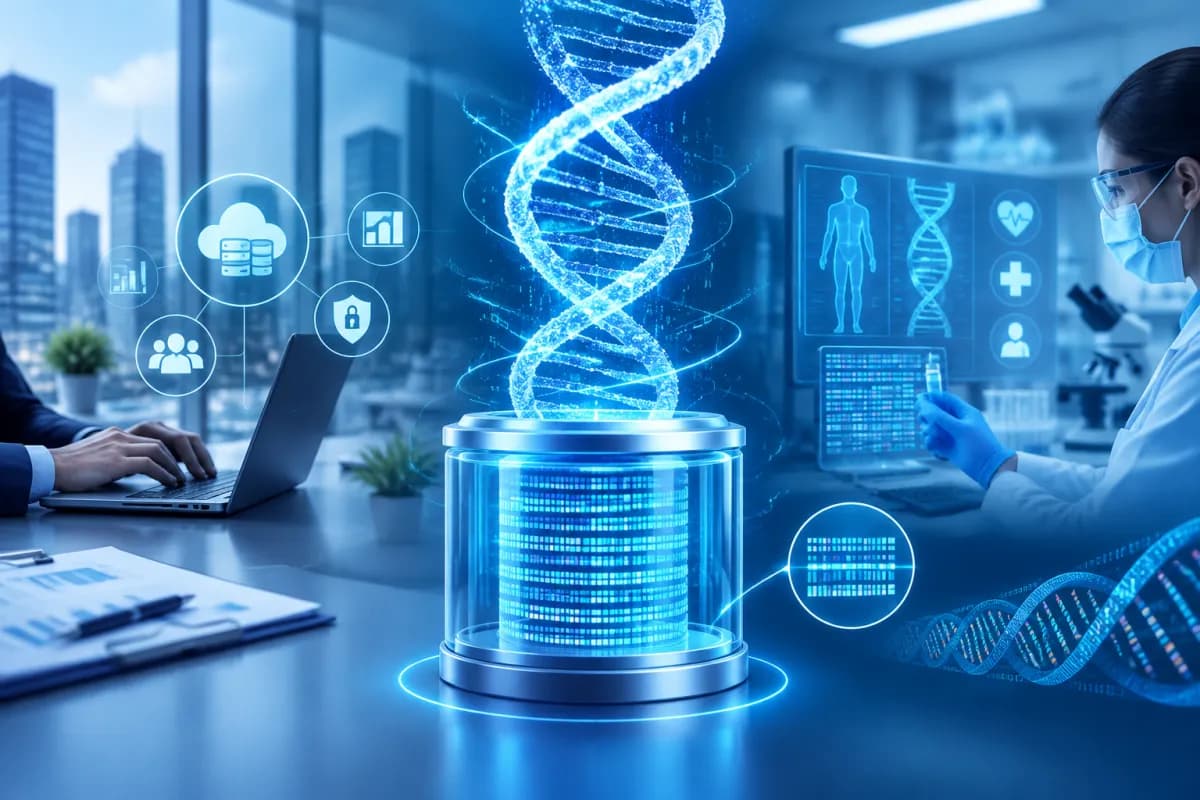
Digital data volumes are growing rapidly across businesses, hospitals, and research organizations, while traditional storage media have limits in capacity and lifespan and require ongoing maintenance. To meet the need for long-term information preservation, DNA data storage is being studied as a new option: encoding digital data into synthetic DNA sequences, then preserving and decoding them when needed.
This technology is not ready to replace hard drives, servers, or cloud storage in day-to-day operations. However, for high-value data that is accessed infrequently but must remain intact for decades, DNA could offer a promising approach. This article explores how it works, where it could be used, and what businesses and the healthcare sector should consider.
What Is DNA Data Storage?
DNA data storage is a method of converting a computer’s binary information into a sequence of DNA building blocks. Instead of writing data onto magnetic surfaces or semiconductor chips, the system uses symbols corresponding to DNA’s four bases: A, C, G, and T. To retrieve the data, the DNA sequence is read using sequencing technology, and software converts the results back into the original digital data.
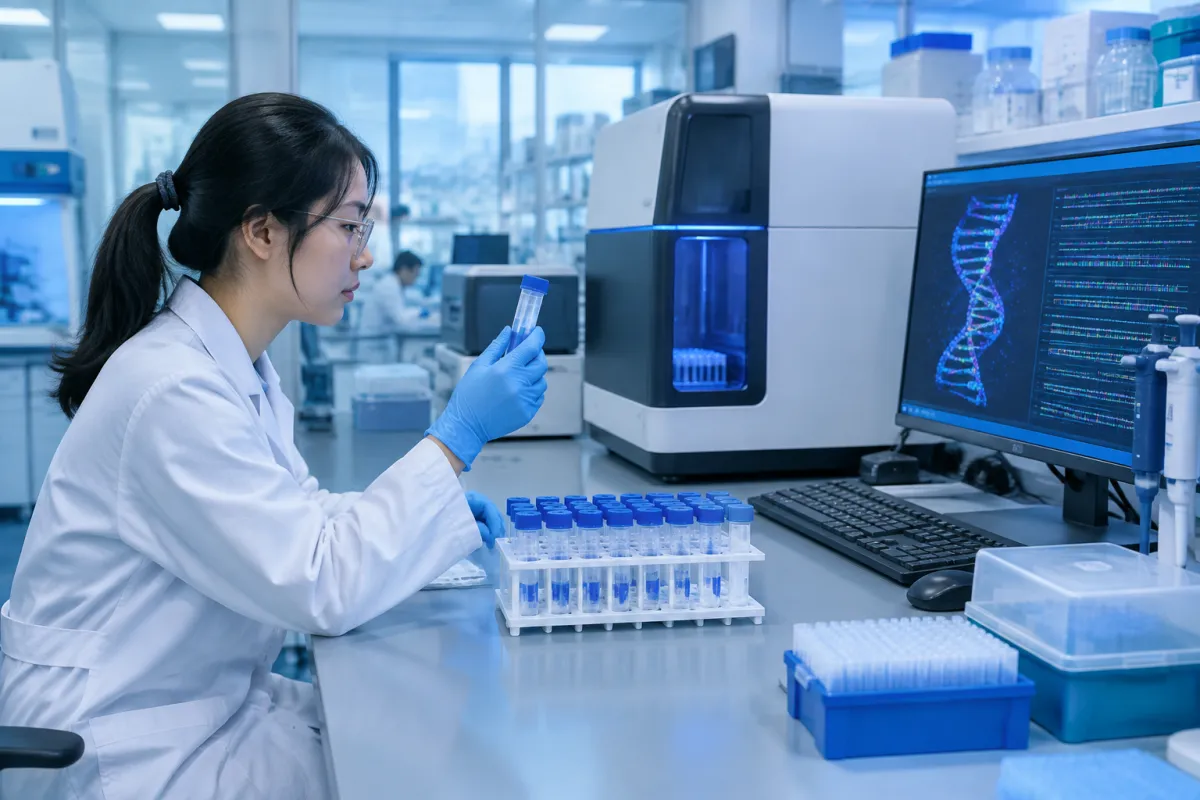
The process typically involves several key steps:
- Encoding: Software converts data into a suitable sequence of symbols and adds error-checking information to help detect or recover corrupted data.
- DNA synthesis: The encoded sequence is made into synthetic DNA strands. This is an artificial material for storage, not DNA taken from a patient or natural biological sample.
- Preservation: The DNA strands are stored under controlled conditions, typically in a dry form or an environment that helps limit degradation.
- Reading and decoding: When data is needed, sequencing equipment reads the strands, and the system converts them back into files, records, or digital documents.
The appeal of this approach lies in DNA’s extremely high theoretical storage density and its potential to last a long time when stored appropriately. However, laboratory potential should be distinguished from real-world deployment. Synthesis and sequencing costs remain a barrier, while access speeds are not yet suitable for data that needs to be read and written continually.
Use Cases That Could Benefit from DNA Data Storage
Medical Records and Healthcare Data
Hospitals, research institutions, and public health agencies store many types of information with long-term value: patient records, test results, diagnostic images, epidemiological data, and treatment histories. Some of this data must be preserved to support ongoing care, audits, research, or regulatory compliance. DNA data storage could be considered for completed datasets that are rarely accessed but have a clear reason to be retained over the long term.

For example, an organization could explore retaining an archival copy of a standardized healthcare dataset after removing or protecting personally identifying information. In this scenario, DNA would not serve as the electronic record system used every day. Hospitals would still need databases and high-speed backup systems; if appropriate, DNA storage would simply provide an additional long-term storage tier.
Health data is especially sensitive, so any retention plan must include access controls, encryption, key management, and data destruction procedures. Encoding data in DNA does not automatically make it anonymous or immune to risk. Organizations should assess their security obligations and applicable regulations before choosing this technology.
Research Data and Digital Repositories
Research institutes, universities, pharmaceutical companies, and biomedical research teams generate experimental data, analytical results, models, and methodological documentation. Some datasets are difficult to reproduce because experiments are expensive, biological samples are scarce, or research conditions exist only during a particular period. DNA data storage could be investigated as an option for preserving copies of these important results.
The value lies in more than the result files themselves. Data should be stored alongside information about formats, units of measurement, software versions, how it was generated, and usage rights. Without context, even an intact file may no longer be meaningful years later. For this reason, DNA preservation should be part of a research data management plan, rather than treated as a standalone solution.
Digital Documents and Business Records for Long-Term Preservation
Businesses may hold contracts, legal records, design documents, product data, decision minutes, and historical records that need to be retained for reference. Archives, libraries, museums, and cultural organizations also need to preserve digital documents, audio recordings, films, and digitized collections. For material that rarely changes and is seldom accessed, DNA data storage could be explored as a specialized storage tier.
Not every file is a good fit. Data that needs frequent updates, active processing, or instant retrieval should remain on conventional storage infrastructure. A practical approach is to classify data by value, access frequency, retention period, and importance, then identify which categories could benefit from a long-term storage technology.
Potential Benefits and Limitations to Consider
High density: DNA has the potential to store large amounts of information in a very small volume of material. This could be useful for storing vast quantities of data in limited physical space, if production and retrieval technologies become efficient enough.
Long-term preservation: Under suitable conditions, DNA can retain information for a long time. Longevity is not guaranteed, however: temperature, humidity, packaging, synthesis quality, and error-control procedures all affect the result.
Less direct dependence on a particular generation of hard drives: DNA data could reduce some of the pressure to continually replace obsolete physical storage media. Even so, reading the data still requires sequencing equipment, software, encoding standards, and technical expertise. Maintaining the tools needed to read it is therefore part of the preservation challenge.
Current limitations include the cost of synthesis and sequencing, read and write times, the ability to update data, the level of standardization, and the scale of commercial services. Finding a specific file in a DNA archive also requires suitable indexing and data organization. These factors make the technology better suited to cold storage—data retained for a long time but accessed infrequently—than as a replacement for systems used in day-to-day operations.
DNA storage should be viewed as a potential complement for data with long-term value, not an immediate replacement for existing storage infrastructure.
What Businesses and Healthcare Organizations Need to Prepare
Before testing DNA data storage, organizations should define the business or specialist need the technology is intended to address. If the goal is simply to reduce server capacity, they should compare it with more mature options such as cold storage, offline backups, and data optimization. If the goal is to preserve especially important data over the long term, they should assess the benefits, lifecycle costs, and retrieval requirements.

- Classify data: Determine which data needs to be retained, for how long, who can access it, and whether it can be recreated if lost.
- Standardize formats: Preserve descriptive information, data structures, versions, and interpretation guides so future users can understand the content.
- Assess security and privacy: Prioritize encryption, key management, access controls, auditing, and the handling of sensitive data, especially in healthcare.
- Run a small-scale test: Choose a valuable dataset that does not affect essential operations, then test encoding, preservation, retrieval, and error recovery.
- Maintain multiple copies: Avoid relying on a single method. Establish a backup plan, store copies in different environments, and regularly test recovery capabilities.
For healthcare facilities and research organizations, implementation also requires coordination among technology experts, data managers, legal teams, information security specialists, and subject-matter departments. A technically successful test is not enough to prove that an approach is suitable operationally, financially, or from a compliance perspective. Define evaluation criteria from the outset to determine whether it should be scaled up.
Conclusion: Preparing for the Future of DNA Data Storage
DNA data storage has the potential to help preserve medical records, research data, and digital documents that need to be retained for a long time. Its high storage density and preservation potential are promising, but cost, retrieval speed, standardization, and security requirements must be addressed before widespread adoption. For businesses and healthcare organizations, the right steps today are to classify data, strengthen information governance, and monitor real-world trials.
LilyTech supports businesses with technology consulting, website and app design, management system implementation, and digital platforms tailored to operational goals. Contact LilyTech for advice on assessing your data needs, choosing storage solutions, and building a transformation roadmap suited to your organization.

