
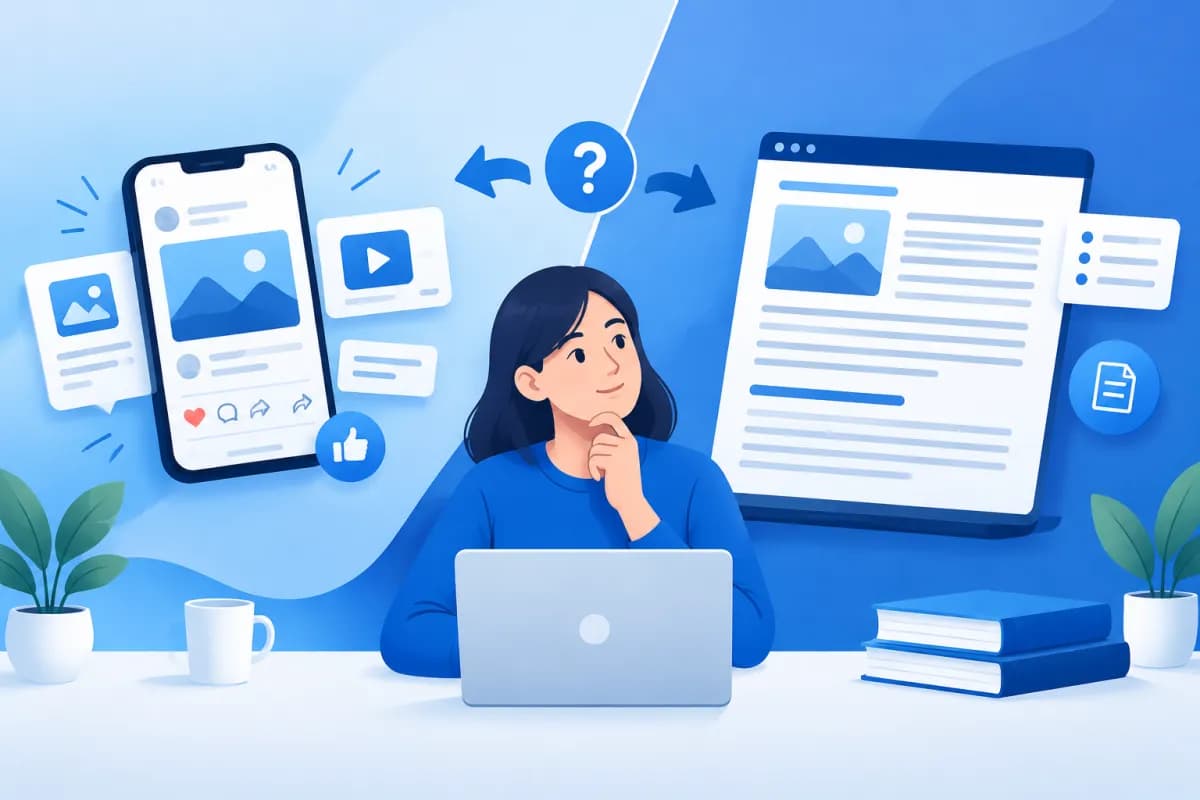
“What is mini content and how is it different from long-form content?” is a common question among businesses looking to create short, easy-to-consume content for social media and digital channels. The more widely used terms are “mini content” and “microcontent,” which refer to concise pieces focused on a specific message or idea.
Mini content and long-form content both play a role in a marketing strategy, but they serve different goals. Understanding the strengths, limitations, and ways to combine these formats can help businesses allocate resources wisely and reach customers more effectively, rather than focusing solely on content length.
What is mini content?
Mini content is short-form content designed to help viewers quickly understand information, remember a message, or take action. It can take the form of a social media post, short video, simple infographic, quote, quick tip, brief email, or advertising copy.

The defining feature of mini content is not simply its word count. It should focus on one central idea, communicate it clearly, and suit the context in which people consume it. A few lines containing several unrelated points may not be effective mini content. By contrast, a short video with a prominent message and clear presentation can deliver real value.
Mini content often appears on fast-moving channels such as TikTok, Facebook, Instagram, LinkedIn, YouTube Shorts, and in-app notifications. Businesses can also use it in email campaigns, digital advertising, and customer service.
How is mini content different from long-form content?
The difference between mini content and long-form content is not simply the number of words. The two formats take different approaches, offer different levels of detail, and play distinct roles in the customer journey. The comparison below offers a quick overview:
- Goal: Mini content captures attention, delivers an idea quickly, and encourages engagement. Long-form content explains a topic in greater depth, establishes expertise, and helps readers evaluate a decision.
- Depth: Mini content focuses on one message or one part of a topic. Long-form content can cover context, causes, solutions, examples, and implementation guidance.
- Consumption: Mini content is usually viewed or read quickly and suits the mobile browsing experience. Long-form content asks readers to spend more time and give it more focused attention.
- Common channels: Mini content works well on social media, in ads, and in short videos. Long-form content is often most effective on blogs, how-to pages, in-depth resources, and detailed emails.
- Metrics: Mini content is often measured by views, engagement, completion rate, saves, and clicks. Long-form content can be evaluated by reading time, search rankings, consultation sign-ups, and conversions.
These are general trends, not absolute rules. A short video can still drive conversions if it has a clear call to action. A long blog post can attract plenty of traffic but few leads if it does not meet readers’ needs.
Strengths and limitations of each format
Mini content: quick and accessible
The biggest advantage of mini content is that it lowers the barrier to engagement. People can pick up a tip, product detail, or brand story while scrolling social media without having to set aside much time. Businesses can also test different messages, topics, and formats to discover what resonates with their target audience.

Short-form content is especially useful for maintaining a regular presence, building brand awareness, sharing promotions, or directing users to more in-depth content. A consistent series of short posts can help a brand sustain engagement and stay top of mind.
However, mini content has limits when it comes to depth. If a message is cut down too much, it can become generic, lack supporting evidence, or cause confusion. Publishing a lot of short content without a clear direction can also dilute a brand and make it harder to build lasting trust.
Long-form content: in-depth and enduring
Long-form content gives businesses room to address an issue comprehensively. Analytical articles, guides, case studies, and detailed service pages can answer customers’ questions, demonstrate expertise, and support the decision-making process.
For SEO, long-form content can cover a topic broadly, address related search intents, and create a useful experience when it is well researched and organized. However, length alone does not guarantee rankings or results. A rambling, repetitive article with no practical information will struggle to hold readers’ attention. Long-form content also typically requires more time for research, editing, and updates.
Choose a format based on your goals and the customer journey
Businesses should start by asking: What do we want this content to help customers do? Mini content is often a good fit when the goal is to capture attention, build awareness, or remind users of a benefit. Long-form content tends to work better when customers need to understand a solution, compare options, assess risks, or find specific guidance.

Use the following as a guide:
- Build awareness: Use short videos, images with clear messages, engaging questions, or quick tips to reach more people.
- Explain a product: Pair a short post highlighting one benefit with a detailed page or long-form article covering features, processes, and use cases.
- Generate leads: Use mini content to spark interest, then guide interested users to in-depth resources, a form, or a relevant consultation.
- Build trust: Invest in guides, expert analysis, and project stories backed by data, then repurpose their key ideas into multiple short-form pieces.
- Support customers: Send notifications, quick instructions, or brief answers for simple tasks; prepare more detailed resources for multi-step issues.
The customer journey rarely happens through a single piece of content. Someone might come across a short video, search Google for more information, read a blog post, and only then contact a business. Each format should therefore have a specific role and guide people to the next step, rather than compete with other content or repeat the same message.
How to create effective mini and long-form content
To make mini content impactful, focus each piece on one main idea. Start with a clear benefit, problem, or question that attracts the right audience. Use straightforward language, specific examples, and a format suited to the platform. End with an achievable call to action, such as saving the post, commenting, viewing a guide, or learning more.
For long-form content, first identify the audience, search intent, and questions the piece needs to answer. Organize information logically, break it into easy-to-scan sections with clear headings, prioritize useful material, and include examples relevant to business contexts. After publishing, monitor performance and update the content as information, products, or customer needs change.
An efficient way to make the most of your resources is to create long-form content as a foundation, then turn its key points into mini content. For example, a guide to choosing software could become a series of videos answering common questions, posts explaining individual selection criteria, and an infographic summarizing the process. Repurposing content this way keeps the message consistent while adapting it to how people consume content on each channel.
Finally, evaluate performance based on your goals rather than looking only at views or word count. For awareness campaigns, track reach and meaningful engagement. For lead generation, look at sign-ups, consultation requests, and lead quality. Real-world data will help businesses adjust their topics, formats, and publishing frequency.
Conclusion
Mini content is a short format focused on one message, making it useful for capturing attention and sustaining engagement. Long-form content is better suited to in-depth explanations, SEO, and building trust. Businesses do not have to choose one or the other: combining short- and long-form content based on goals, channels, and each stage of the customer journey is often more effective.
If your business needs a content strategy aligned with your website, SEO, and digital marketing, LilyTech can advise on choosing formats, organizing topics, and developing an approach that supports your business goals. Contact LilyTech to discuss your needs and find the right solution for your brand.

